

The Maritime Union of Australia is calling for a 28-hour week and no loss of pay for its members that are impacted by DP World’s automation plans for its Australian terminals.
“If DP World wants AI and automation, then they must pay the social dividend,” the Maritime Union of Australia (MUA) said in a statement.
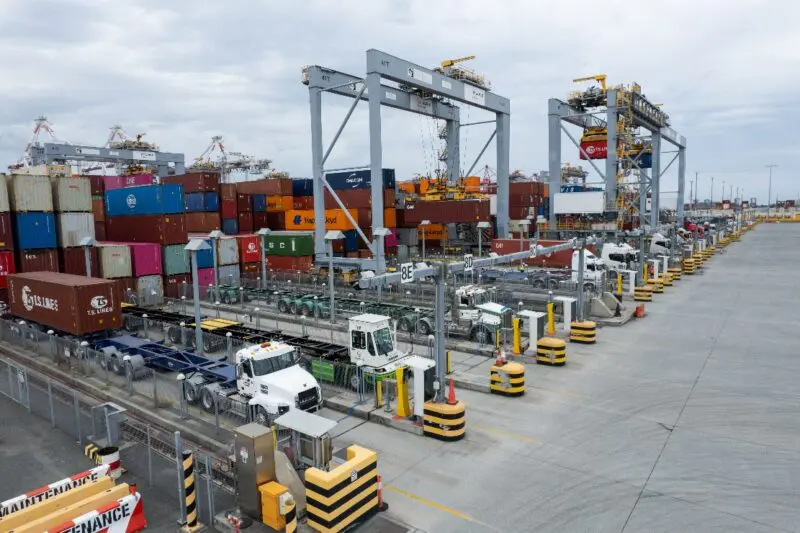
DP World Australia is currently in the process of consulting over its automaton plans for its terminals Sydney, Melbourne and Fremantle, and to introduce automated horizontal transport in the form of IGVs (Intelligent Guided Vehicles) to its Brisbane operation.
The MUA is running a campaign opposing DP World’s plan. At the same time it is calling for the federal government to step and regulate AI “to protect Australian jobs and supply chain sovereignty.” The union has now called for DP World to share the benefits of AI by reducing working hours for stevedores without reducing wages.
“The new technology doesn’t have to cost our members their jobs or put their livelihoods at risk just so a terminal operator can boost profits. It should be used to improve workers’ lives, not destroy them,’ the MUA said. “A key demand is a 28‑hour week with no loss of pay for all workers whose jobs are in the crosshairs of AI and automation.”
The “efficiency dividend”
The MUA is not alone in calling for the benefits of AI and automation to be shared across society, rather than capture by corporate profits alone. In the US Senator Bernie Sanders introduced the Thirty-Two Hour Workweek Act to Congress. It would shorten the standard work week to 32 hours (four days) and cause no loss in pay. Some tech company executives are predicting the four, or even three, day workweek will become common place as AI helps to increase productivity.
The MUA’s proposed 28-hour workweek would see stevedores working four 7-hour shifts. “The MUA is fighting right now for a shorter working week in our disputes with DP World, and we see this as part of a wider struggle, the Union said. “This isn’t just about wharfies – job‑killing technology threatens all workers. The gains from automation and AI should go to the whole working class, not a small group of shareholders.”