

This audio is auto-generated. Please let us know if you have feedback.
At the Automate conference in Chicago, several speakers discussed the latest in simulation technology, how software and physical artificial intelligence is maturing, as well as tips for advancing automation investments.
Here are some of the trends and takeaways from the conference, which was hosted by the Association for Advancing Automation from June 22 to June 25.
Digital Twin experimentation is underway
Engineers are starting to experiment with ways to leverage artificial intelligence in simulation tools to model and rig machine parts and components, “bringing the time and cost to do so down significantly,” Brendan Sterne, chief product officer at automation technology company Vention, said.
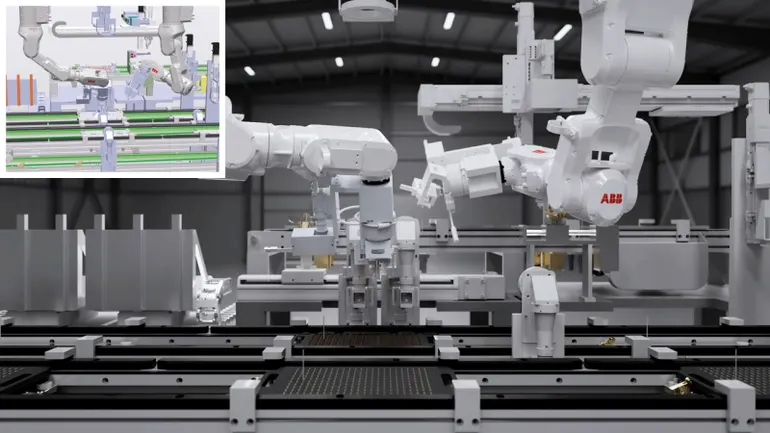
Nvidia and other simulation developers have been partnering with companies such as Rockwell, Fanuc and ABB, on ways to integrate their technology with robotics-focused simulation tools to leverage each others’ strengths. Sterne said engineers are starting to bridge the two tools so they can get realistic robotic motion inside their simulations.
They are also leveraging external large language models like Claude to pull technical specifications, requests for quotations, and other information to do “smarter rigging” and control the simulation tool, he said. Engineers are able to do this through an agent interface known as an MCP, or model context protocol.
“There is now a rush for a lot of the tool vendors to add MCP support,” Sterne said.
Historically, simulation tools have been difficult and expensive to use. However, AI has advanced the technology, brought costs down and opened opportunities for design integration, Sterne said.
“We’ll be able to do iterations in the digital world, so that the first time we assemble it, it’s right and it works,” Sterne said.
Software and physical AI are maturing
While equipment suppliers continue to develop new technologies and push into new markets, they’re making a concerted effort to drive software and automation toward maturity. That includes physical AI, or the integration of AI with robotics.
“Physical AI is a huge buzzword here at the show,” Josh Leath, senior product manager for thermal automation at Yaskawa Motoman, said. “Some stuff has been kind of tried for a few years, on and off, and now we’re trying to get to the point of maturity with those.”
In the future, AI development will enable robots to understand goals, program themselves and adapt in real time to operate more intuitively and autonomously, he said.
These advancements also are shifting robotics to a new programming style: tasks and skills. A task is a goal-oriented activity that a robot carries out, such as assembling a product, whereas a skill is a basic robot capability, such as grasping or detecting objects, Leath explained. The incorporation and advancement of AI and sensors will continue to push robots into areas previously considered “too variable,” he said.
As it currently stands, “AI is not all that” for automation and requires configuration for each individual process, Patrick O’Neil, director of sales engineering at Acme Manufacturing, said. “It’s going to get better, but it does take a considerable amount of work. We’re not done.”
The importance of further boosting AI capabilities was evident in discussions of hardware-focused companies expanding into software.
Software is playing a much bigger role “and it is bringing us the flexibility, the use of programming, the ability to generalize to edge cases and so forth,” Mikell Taylor, director of robotics strategy at General Motors, said.
Integrating and advancing both hardware and software is key to holistically serving customers, speakers said. Plus, viewing the two spaces as part of a larger ecosystem optimizes data collection and use, which ultimately sits at the heart of robotics.
“From the software perspective, the thing that I would highlight is the ability to access data coming out of those robots. Because in order to work in the physical world, you need physical data,” Justin Brown, chief commercial officer at robotics technology company Teradyne, said. “Data’s got to come from a multimodal approach. It’s got to come from sensors. It has to come from vision.”
Labor shouldn’t be the defining reason to automate
Although companies look to labor savings as one of the benefits for automation, that shouldn’t be the driving force behind their digital transformation plans, Marc Fuentes, VP of commercial growth at Eclipse Automation, said.
“Most finance committees are just not going to go for labor savings,” he said. “If we lead with quality, throughput and risk resilience in our proposals, we’re seeing a much better response in terms of how the finance committees are measuring us, how they’re holding us accountable and how we’re seeing much more co-creation with the manufacturers that we’re working with.”
There is also a negative sentiment around pilot projects, Fuentes said. In particular, he said there’s a myth that these are where business cases go to die slowly.
“I think pilots work,” he said, but it’s easy to feel like they’re side projects that don’t directly benefit the business or that waste employees’ time.
“The bias towards small, safe, reversible, defaultable pilots, is the single biggest reason why I think this industry is probably 24 years behind the tech,” Fuentes said. “That consistent move of stepping and tiptoeing into the actual technology that’s proven is what’s holding us back.”