
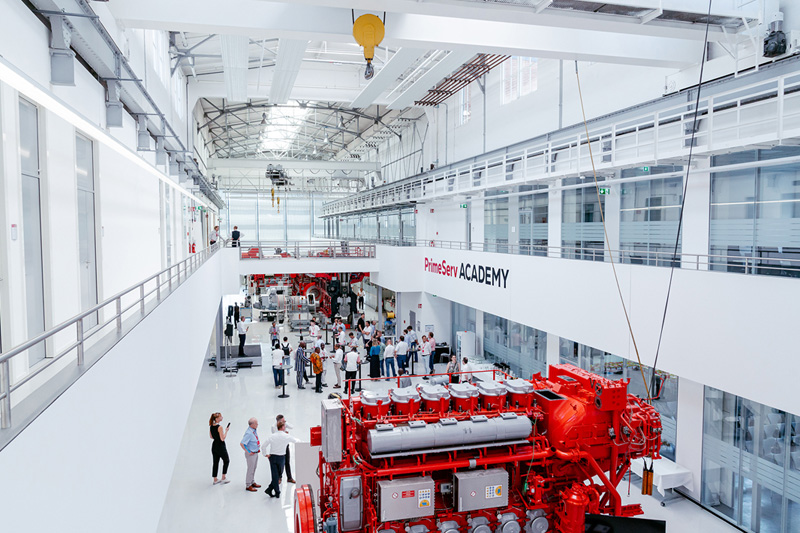

Everllence has unveiled the expansion of the PrimeServ Academy at its Augsburg site.
The company said in a press release that the PrimeServ Academy in Augsburg is Everllence’s hub for training on large, medium-speed engines and turbochargers and that, in recent years, an average of around 1,500 people have participated in training there annually.
Participants are evenly split between customers and employees from Everllence’s global, after-sales organization.
The official opening took place as part of the Technology Fair, an annual customer event that Everllence recently held for the sixth occasion and that had 50 participants.
Uwe Lauber, CEO of Everllence, said: “With the expansion of this PrimeServ Academy, we are investing 6.5 million euros in the future of the site and strengthening Augsburg as a key training center for our customers and employees from the global, PrimeServ after-sales organization.”
Holger Gehring, head of PrimeServ Academy Augsburg, said: “The extended PrimeServ Academy now also places a special focus on our expanded engine portfolio, which is increasingly shifting toward climate-neutral fuels such as green methanol and methane.”
“New fuels bring new challenges for our customers. We support them, not just with our future-oriented technologies but also by working closely with them throughout our engines’ entire lifecycles with tailored training.”
By increasing floor space from around 1,700 to approximately 3,000 square meters, the company said it is responding to the growing demand for training driven by new technological developments.
As part of the expansion, a larger workshop, four additional training rooms and a dedicated area for online formats were added to existing facilities.
Another building directly adjacent to the PrimeServ Academy, dating from 1888, was fully renovated and converted into a training center over about one and a half years.
Demand for training has increased significantly in recent years, driven in part by technological developments in engines, automation and injection systems, and turbochargers, as well as by the growing use of climate-neutral fuels.
At the same time, there remains strong demand for hands-on courses for older installations, the company stated.