

For decades, terminals scaled by addition. More cranes, more yard equipment and more infrastructure. But today’s terminal bottlenecks are no longer defined by capacity alone.
In modern ports, adding more assets doesn’t necessarily improve throughput. In fact, it often exposes the inefficiencies that already exist between systems that were never designed to operate together.
For the port of the future, performance will be determined by how the entire terminal functions as a system — communicating, anticipating and adapting to act as one. Not sheer capacity. But how effectively capacity is controlled.
Extending from reliable components to coordinated systems
For decades, TMEIC has been synonymous with reliable motors and drive systems. That foundation remains critical. Solutions like the TMdrive-10e3 drive continue to deliver the precision, durability and diagnostic visibility terminals depend on for high-performance crane motion.

But ports struggle when operations fall out of sync. A crane completes a move, but yard equipment is delayed. Trucks arrive faster than gates can process them. Power demands spike in one area while capacity sits idle elsewhere. Individually, these missed opportunities quietly undermine efficiency.
Collectively, they snowball into congestion, staggered performance and diminished throughput.
 Terminal coordination is TMEIC’s speciality
Automation and electrification are not separate challenges. The terminal of the future integrates them into a unified framework that connects gate, yard, quay and rail operations. Instead of just adding new technology, TMEIC experts coordinate terminal operations into one intelligent, synchronised system.
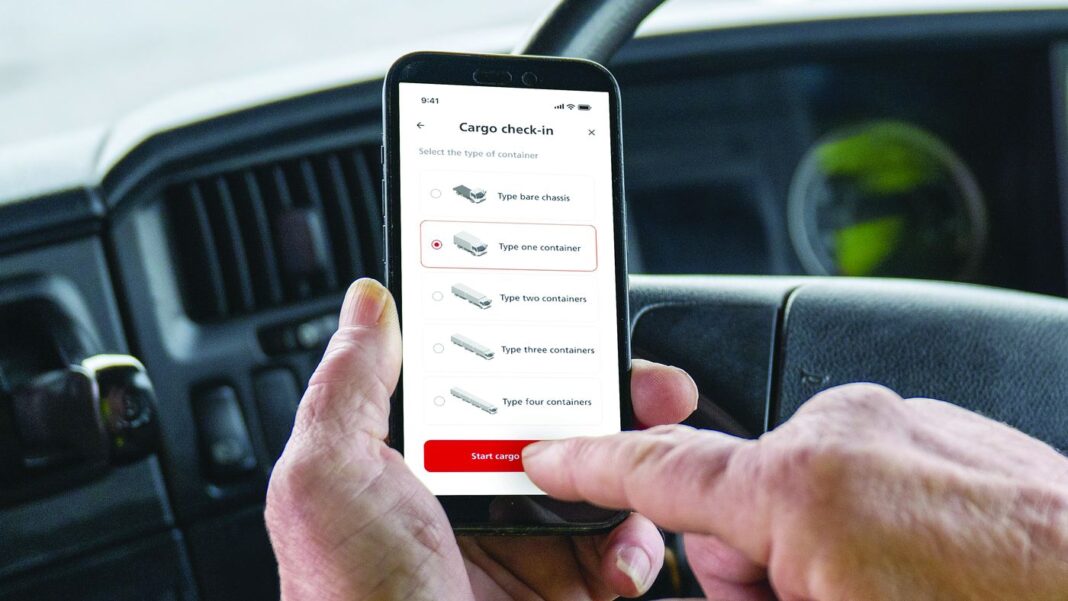
At the landside interface, one of the company’s latest innovations introduces a new model for terminal interactions and truck processing. Pulse Mobile sets a rhythm not just for faster gates, but predictable flow.
Electrification and integration go hand-in-hand
As ports transition from diesel to electric, energy isn’t just a utility — it is operational infrastructure. Electrified cranes, shore power, microgrids and charging systems all place new demands on terminal coordination. Without integrated control, electrification can introduce instability as readily as it reduces emissions.
TMEIC’s solutions span substations, crane electrification, shore power, microgrids, charging systems and advanced energy management systems that balance demand, maintain grid stability and support long-term resiliency. Technologies like the E-Tanker mobile charging solution extend electrification into yard operations. Like their other modular solutions, it can be implemented incrementally and integrated with existing equipment and third-party systems, allowing terminals to modernise without significantly disrupting operations.
Control defines performance
The port of the future will not be defined by the amount of equipment it has. It will be defined by how intelligently that equipment works together.
That shift demands a different kind of partner: one that can integrate motion, automation and energy into a single control layer. TMEIC’s evolution reflects that shift. Because capacity is rarely the constraint. Control is.