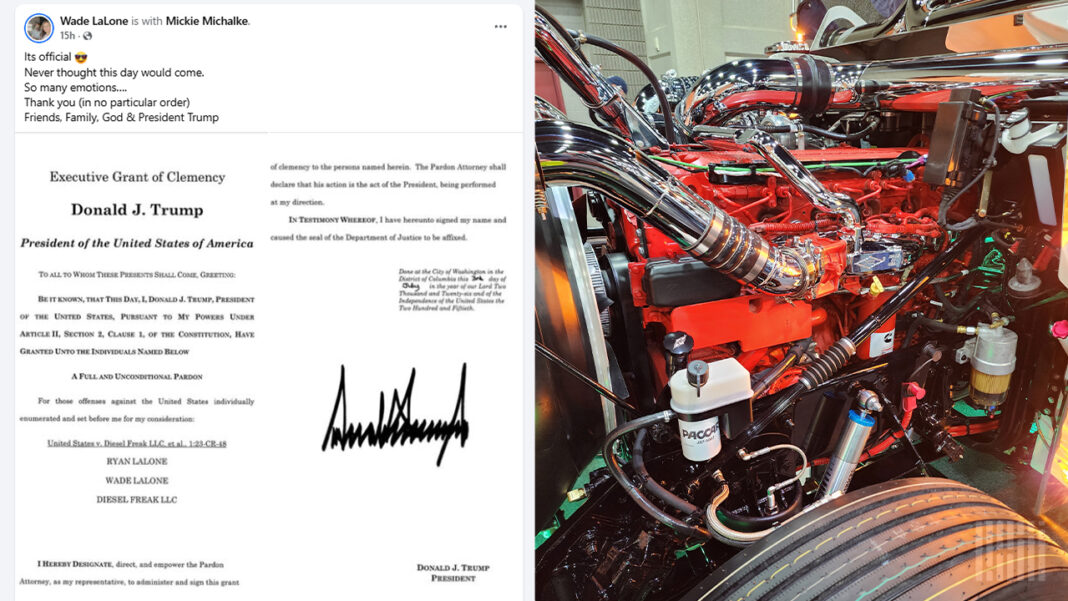

On Thursday night, Wade LaLone posted a photograph to Facebook showing off his two-page pardon, AKA, “Executive Grant of Clemency,” signed in the iconic Trump thick black Sharpie strokes and dated the third day of July in the year of our Lord Two Thousand and Twenty-six. Wade’s caption: “It’s official. Never thought this day would come. So many emotions.”
Several received a full and unconditional pardon in United States v. Diesel Freak LLC, et al., case number 1:23-CR-48, in the Western District of Michigan. Three names appear on it: Ryan LaLone, Wade LaLone, and Diesel Freak LLC, the Gaylord, Michigan, performance shop the brothers built. In 2023, federal prosecutors charged the LaLones and nine other individuals in one of the largest criminal diesel tampering cases ever brought, a sweep that also pulled in Accurate Truck Service and a web of associated fleets. The brothers each received a one-year probation. Their business took a felony.
They were not alone on the pardon list. Trump announced Friday on Truth Social that he had signed pardons for people who were, in his words, persecuted by the Biden Administration and sent to prison for fixing their car. A White House official later confirmed 11 names in total: the LaLone brothers, Matt Geouge, Tim Clancy, Mackenzie Spurlock, Joshua Davis, Barry Pierce, Aaron Rudolf, Adam Kidan, Jack Harvard, and Jonathan Achtemeier. According to a Fox News review of federal court records, at least eight of them were diesel mechanics or tuners prosecuted for selling or installing devices that bypass federally required emissions controls.
Geouge’s case shows the scale of the market the government was trying to kill. According to his December 2021 plea agreement, the two companies he ran grossed more than $10 million from the sale of illegal tuning devices alone.
The “system” the EPA built
To understand why grown men went to federal prison over exhaust pipes. You have to understand what is hanging off the back of every diesel truck built since 2007, and why drivers hate it.
Modern diesel emissions control is a stack of four interlocking systems. Exhaust gas recirculation, or EGR, routes a portion of exhaust back into the intake to lower combustion temperatures and cut nitrogen oxide formation. The diesel particulate filter, or DPF, is a ceramic honeycomb in the exhaust stream that traps soot, then periodically burns it off in a process called regeneration, which dumps extra fuel into the exhaust to hit temperatures around 1,100 degrees. Selective catalytic reduction, or SCR, injects diesel exhaust fluid, the urea and water mix every trucker knows as DEF, into the exhaust to convert nitrogen oxides into nitrogen and water. Watching over all of it is the onboard diagnostic system, the OBD, a network of sensors that monitors every component and reports faults.
The OBD isn’t just about diagnostics; it enforces compliance. Run out of DEF, or throw a sensor code the system reads as tampering or malfunction, and the engine control module begins derating the truck. First, it cuts power. Then, under the inducement strategies EPA required manufacturers to build in, it can limit the vehicle to as little as 5 mph. The industry calls it limp mode. A loaded truck limping at 5 mph on an interstate shoulder is a stranded asset, a missed delivery, and, for an owner-operator, sometimes the difference between making a truck payment and missing one.
The failure rate of these systems is extreme. Brad Bylsma, the state equipment fleet manager for the Alaska Department of Transportation, said in March that DEF systems account for a significant portion of the maintenance issues and costs across state-owned diesel vehicles. My personal 2023 RAM Cummins delete kit went from $1800 or less for 2022 and older models to $7,000 for 2023 and newer models. At 68,000 miles, the Cummins engine, which would probably outlive me, could no longer operate due to a DPF failure that required a complete emissions system replacement. That was at only 68,000 miles! The truck was over $65,000 new.
DEF freezes at 12 degrees Fahrenheit. Sensors foul. DPFs clog on trucks that do a lot of low-speed, low-temperature work, which describes school buses, ambulances, plow trucks, and farm equipment, the exact vehicles that kept showing up in these criminal cases. Sen. Dan Sullivan of Alaska defended one of the pardoned men by noting that his shop modified emissions systems so that trucks would not shut down in subzero conditions.
The delete economy
When a compliance system strands trucks over sensor faults, a market emerges to circumvent it. That market industrialized years ago, and it splits into a few distinct products that get lumped together in coverage but should not be.
A full delete is the removal of the hardware, the DPF, the EGR cooler and valve, and the SCR system, replaced with a straight pipe and block-off plates. The hardware is only half the job, because the OBD will detect the missing components and derate the truck. So every delete requires a tune, an ECU reflash, or a plug-in tuner that reprograms the engine computer to stop looking for the emissions equipment, stop running regens, stop demanding DEF, and stop derating. The tune is the actual defeat device in the eyes of the law, and it is what Geouge, the LaLones, and most of the others were prosecuted over. Troy Lake, the Wyoming mechanic whose case started this entire political avalanche, was convicted specifically for directing employees to disable the onboard diagnostics on at least 344 heavy trucks between 2017 and 2020.
Bulletproofing is a different animal, and the industry does itself no favors by blurring the line. Bulletproofing means hardening the known failure points and upgrading EGR coolers, head studs, oil coolers, and sensors so the emissions system survives rather than being removed. It is legal, it is legitimate, and shops that do it have watched customers walk out the door to delete shops because deleting was cheaper and more effective at solving the reliability problem. That is the perverse economics the EPA, and I’d argue the environmental left, created because they lack an understanding of how diesel and fossil fuels drive this country and this country’s supply chain. The legal fix competes against an illegal fix that works better.
The economics of a deleted truck mean no derates. No DEF, which runs a real cost per gallon across hundreds of thousands of miles. No regen cycles and the fuel penalty they carry. No DPF replacement, which can run $3,000 to $7,000 for the filter alone on a Class 8 truck, and considerably more with labor and related sensors. The EPA Air Enforcement Division estimated years ago that more than half a million diesel pickup trucks alone had been deleted over roughly a decade, and environmental groups cite similar figures for the broader fleet. Enforcement never came close to touching the actual population of deleted vehicles. It touched the shops. That is why mechanics went to prison while the trucks they worked on kept rolling.
Cleaner than it ever got credit for
The diesel engine that entered the DPF era was already a radically cleaner machine than the one that came before it.
Between the early 1990s and 2007, diesel emissions dropped by an order of magnitude through combustion engineering, injection timing, turbocharging, and, critically, the 2006 mandate for ultra-low-sulfur diesel, which cut fuel sulfur content from 500 parts per million to 15 parts per million. Particulate matter and NOx standards tightened roughly 90 percent across that stretch. Those gains came from improving the engine itself. They did not leave anyone stranded on the side of the road.
The 2007 DPF mandate and the 2010 NOx standard that effectively required SCR and DEF went after the final increment, and the way to describe that increment is real but marginal, purchased at enormous cost and the price was a compliance apparatus that added five figures to the cost of every truck, created failure modes that did not previously exist, punished the smallest operators hardest and manufactured a criminal underground out of the mechanics those operators depended on. Fifteen years in, the fair question is whether the same money, pointed differently, would have bought more clean air with less wreckage.
The partisan ping-pong
While I celebrate President Trump’s action on this, the politics of this issue are messy. The EPA raid on Troy Lake’s shop happened in 2018, during the first Trump administration. The National Compliance Initiative that made defeat devices a top enforcement priority launched in 2019, also under Trump. The Volkswagen scandal in the mid 2010s poured accelerant on all of it and gave prosecutors a template. The Biden years then took that machinery and ran it hard. EPA finalized 172 civil defeat-device cases between 2020 and 2023, imposing $55.5 million in penalties, and the criminal cases stacked up alongside them. Lake pleaded guilty in June 2024, was sentenced that December to a year and a day, and reported to FCI Florence in February 2025, where the Bureau of Prisons put him to work in the prison diesel shop fixing the same OBD faults that put him there. He spent his 65th birthday inside. I wrote about his case in my book as well as others.
Then the pendulum swung with force. Sen. Cynthia Lummis of Wyoming made Lake a cause, wrote directly to Trump in September 2025 and introduced the Diesel Truck Liberation Act the following month, a bill that would strip EPA authority over vehicle emissions enforcement, bar prosecutions for tampering and vacate existing sentences. Trump pardoned Lake in November 2025. In January 2026, Deputy Attorney General Todd Blanche ordered federal prosecutors to drop all pending criminal defeat device cases and bring no new ones, a policy the DOJ Environment and Natural Resources Division announced, fittingly for this era, in a post on X. Friday’s 11 pardons finished the job for the men already convicted.
So in the span of eight years, the same government raided a shop, prosecuted its owner, imprisoned him, pardoned him, stopped prosecuting the conduct entirely, and began legislating to erase the crime. If you are a fleet planning a five-year equipment strategy, that’s a coin flip that reruns every election. The coin will flip again. Nothing in the pardons or the Blanche memo repeals a single word of the Clean Air Act. Civil penalties of $45,268 per tampered engine and $4,527 per defeat device sold remain fully on the books, and a future administration can restart criminal referrals with a one-page memo the same way Obama ended English language proficiency, and Trump started enforcing it again. Common sense has totally failed, and instead we live in a hot-topic, narrative-driven policy-making hamster wheel.
What the pardon doesn’t buy back
The Diesel Truck Liberation Act would vacate sentences and expunge records, but as described, it appropriates nothing. Congress is the only body that can actually make these men whole, and the bill written in their honor doesn’t do it.
There’s restitution too, right? No. This was settled in 1877 in Knote v. United States. Once a fine or forfeiture has entered the Treasury, a pardon confers no right to a refund. The Constitution bars money from leaving the Treasury without a congressional appropriation, and a pardon is not an appropriation. So whatever portion of the fine remained unpaid on July 3 is wiped out because a full pardon applies to all remaining punishment. Whatever was already paid stays paid, forever, unless Congress passes a bill to give it back. Troy Lake’s fines, the Diesel Freak corporate fine, Geouge’s forfeitures on a $10 million operation. If it was paid, the government keeps it while simultaneously declaring the prosecution was persecution. That contradiction is your government in action.
Defense costs? Even worse. There is no mechanism at all. A defendant who is fully acquitted at trial doesn’t get attorney’s fees back, so a pardoned one certainly doesn’t. The only path is the Hyde Amendment, which requires proving the prosecution was vexatious, frivolous, or in bad faith, and it’s nearly impossible. It’s categorically dead for these men because they all pleaded guilty. The Lake family alone described legal and compliance costs running into the hundreds of thousands on top of the fines, and note that even getting the pardon required hiring a lawyer and a lobbyist, Cables and Daugherty, who represented five of the six in the first batch. (Freedom had a retainer…remember this.)
Restitution? Yeah, right. A pardon reaches restitution the recipient hasn’t yet paid, but money already disbursed to a third party is vested and untouchable. So if Elite Diesel’s $12,500 payment to that Colorado emissions repair program already went out the door, it stays there.
How many are still in the mess? Apparently, someone couldn’t afford the retainer, so their freedom isn’t granted. The 11 pardons are a rounding error against the enforcement footprint. EPA finalized 172 civil defeat device cases from fiscal 2020 through 2023 alone, and civil judgments and consent decrees are constitutionally beyond the pardon power. Every shop operating under a consent decree is still bound by it today. The Diesel Freak case itself charged 11 individuals plus companies, and only the two LaLones were pardoned. Lake’s case swept in eight co-conspirator garages and fleets across seven states. Then there’s everyone convicted in the 2018 to 2024 wave who didn’t have a senator or a lobbyist. The pattern in who got pardoned versus who’s still carrying a felony is a real reporting question, and it’s checkable against court records.
The US is very much a pay-to-play if you require freedom and liberty and a clean record following a bad prosecution from a tyrannical government.
The subsidy nobody will propose
If the federal government has now concluded, through its prosecutors, its pardon pen, and its pending legislation, that criminalizing emissions system removal was a mistake, then it owes the people still stuck with the systems more than a shrug. The government mandated this equipment for every diesel truck sold in America. It collected the compliance cost from every buyer. It is now walking away from enforcing the mandate while leaving the hardware, the failure modes, and the repair bills exactly where they were.
We have a model for how the government changes what is parked in American driveways. It writes checks. The federal EV tax credit paid up to $7,500 per vehicle to move consumers into electric cars, billions of dollars in direct subsidy for a technology transition Washington favored. I would argue that the particular experiment raised costs across the board, on the grid, on insurance pools, on the used market, and on the taxpayers who funded credits that flowed disproportionately to buyers who did not need them. Set my opinion of EVs aside. The precedent stands: when the government wants a different powertrain outcome, it subsidizes the change instead of jailing the mechanic.
So apply the same logic here. If EPA and DOJ no longer believe DPF and DEF mandates are worth criminal enforcement, offer every owner of a DPF-equipped diesel a subsidized path. That could mean funding removal and certified retune in jurisdictions that permit it. Better yet, and more defensible on the merits, it could mean subsidizing repair, replacement and bulletproofing of failing systems so compliance stops being a solvency threat, the same way the Lake case itself already gestured at when the court routed $12,500 to a Colorado program that fixes emissions systems for low-income drivers. That number should have had six more zeros behind it and a federal appropriation, not a restitution line in a criminal judgment.
Pick a lane Washington. Either the equipment matters, in which case help people keep it working, or it does not, in which case stop making small operators eat the cost of your abandoned mandate.
What the pardons don’t fix
A word of compliance reality before anyone reads this weekend’s news as a green light,
Deleting a truck is still a federal civil violation, with penalties that can exceed the truck’s value. California has not gone anywhere, and CARB’s inspection and enforcement apparatus operates independently of whatever mood the DOJ is in. A deleted truck voids its emissions warranty, complicates resale, can fail state inspection regimes, and hands opposing counsel a gift in any crash litigation, because nothing says willful disregard to a jury quite like an illegally modified vehicle. Brokers and shippers pursuing clean-fleet commitments can and do screen for compliance. The 2027 engine standards direct manufacturers to lock down ECUs more tightly, which means the delete window is closing on new iron regardless of what prosecutors do.
Wade LaLone thanked his friends, his family, God, and President Trump. Who ironically charged LaLone under one Presidential term and pardoned under a second term. I do not begrudge LaLone a second of that relief. He and his brother got caught in the gears of a policy the government itself no longer believes in enough to enforce but the trucks are still out there, the systems are still failing, the repair bills are still landing on the people least able to absorb them, and the underlying law is untouched, waiting for the next administration to pick the weapon back up. Eleven pardons ended eleven ordeals. They did not end the disaster. They just stopped punishing people for responding to it.