
Global volatility put pressure on the world’s leading airfreight forwarders last year, but there were still plenty of growth opportunities (full table at end of article).
Last year was a volatile period for the world’s leading airfreight forwarders, with tariff changes reshaping supply chains and major consolidation creating shockwaves in the market.
There was also the US decision to end its de minimis exemption for e-commerce shipments, a market that had been one of the main demand drivers for air cargo in recent years.
However, there were positives too, and as the year progressed, it became increasingly clear that data centres, computer chips and AI-related products were going to provide the airfreight market with its next success story.
The market volatility experienced in 2025 can be seen in the top 25 air forwarders list from consultant Armstrong & Associates, with volumes varying dramatically between players, depending on how their core markets were affected by the Trump administration’s tariff policy.
Overall, the top 25 air forwarders registered a slight 0.1% increase in demand as the volatile market conditions affected performance.
Leaders of the pack
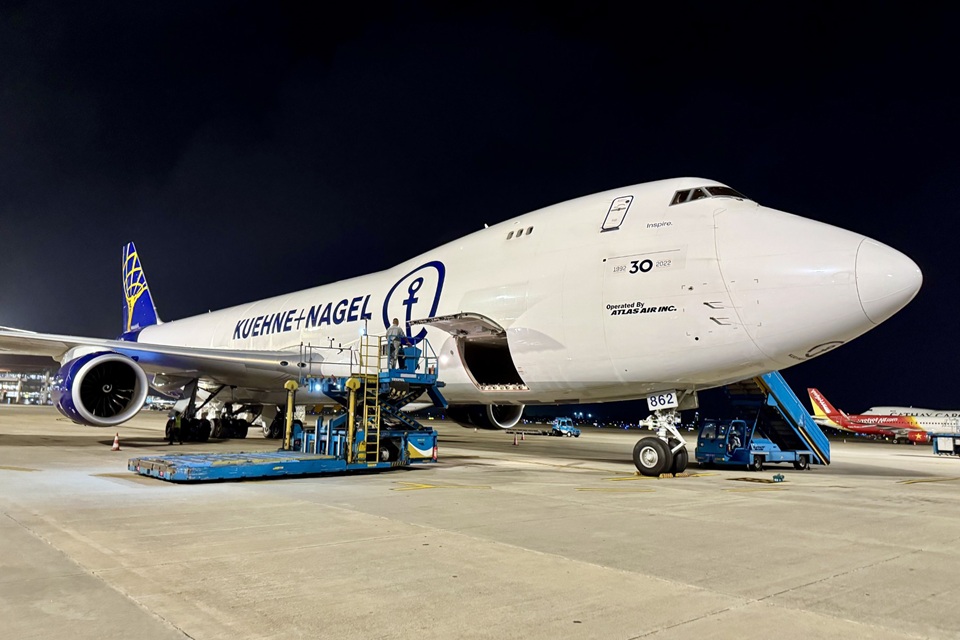
One of the big surprises in the table is that Kuehne+Nagel (K+N) managed to maintain its top spot despite DSV taking over fourth-placed DB Schenker.
Switzerland-headquartered K+N saw its airfreight volumes increase 7% year on year in 2025 to 2,030,280 tonnes, narrowly beating DSV’s 2,013,127 tonnes.
Of course, it should be noted that DSV only began fully including Schenker’s figures in its results from the third quarter, as the deal was not completed until May.
And, in the third quarter of the year, DSV actually edged K+N in terms of airfreight volumes – pointing towards a probable change in leadership this year.
Turning to the trends that affected K+N’s performance last year, the forwarder said the airfreight market in 2025 was characterised by “volatile demand for air transport services following the introduction of trade tariffs”.
China was one of the main countries that was affected by US tariffs and this saw supply chains shift towards Southeast Asia.
There were also waves of front-loading as companies looked to move shipments before the latest round of tariffs kicked in.
However, in the last quarter, K+N reported strong demand for airfreight capacity out of Asia from AI infrastructure developers (hyperscalers)”.
Elsewhere, K+N also benefited from the acquisition of Eastway Global Forwarding, which helped the airfreight business unit expand its portfolio of time-critical aircraft-on-ground services.
Despite the volume increase, the forwarder said that it had faced yield pressure as airfreight rates had fallen compared with the highs of 2024, when the air cargo market was boosted by modal shift due to the Red Sea missile crisis.
This is reflected in air turnover increasing at a lower rate than volumes, improving 3% to Sfr8bn.
Bumper year for DSV
Second-placed DSV had a bumper year in terms of airfreight volume growth, registering an improvement of 44% year on year thanks to its acquisition of DB Schenker.
The acquisition helped DSV leapfrog DHL Global Forwarding into second place and should be enough to hand the company top position in 2026.
The Danish company said that its “organic growth in airfreight was relatively consistent with market growth, after adjusting for the exit of low-yield volumes”.
DSV said that changes in the e-commerce market, led by the US decision to end the de minimis exemption, had a “minor direct impact” on its airfreight operations due to its limited e-commerce volumes.
DSV air revenue for the year was Dkr75.5bn, up 37% compared to 2024. Airfreight gross profit was Dkr16.6bn, an increase of 39%.
The company said of airfreight in 2025: “Overall, modest demand growth, increased capacity and shifts in trade lanes led to flat to slightly negative freight rates compared to last year.”
“The development in revenue was driven by the contribution from Schenker, offsetting lower average freight rates, especially within sea freight,” said DSV.
The Denmark-headquartered company added that in the fourth quarter, technology remained a growth contributor compared to the previous year, despite signs of stabilisation. Meanwhile, automotive was still downtrading.
The year was not quite so positive for Bonn-headquartered DHL Global Forwarding, which saw its airfreight volumes decline by 1% year on year in 2025 to 1.8m tonnes.
2025 revenues for airfreight was €6bn, down 4.6%. Gross profit was down 0.9%.
The company didn’t provide too much specific information on the performance of its airfreight business, commenting that the global forwarding market in 2025 was characterised by ongoing geopolitical conflicts and increasing tariff-related uncertainties.
“The capacity constraints of the previous year eased over the course of 2025, and there was an increasing degree of cautious optimism around the situation in the Red Sea, resulting in reduced freight rates in air and ocean freight.”
The group also noted that data centre demand helped offset slower international e-commerce volumes in its airfreight business, something that has continued to boost the forwarder’s performance this year.
Growth leaders
Two of the fastest-growing forwarders last year were Taiwan-based. Dimerco registered a 16.6% year-on-year increase in air volumes to 271,513 tonnes and Morrison Express saw its volumes improve by 14.9% to 361,600 tonnes.
Taiwan is one of the main beneficiaries of the boom in computer chip demand and this fast-growing segment is likely to have boosted performance at the two companies.
Morrison Express chief executive Asok Kumar even called for more freighter capacity to be added to the market to meet rising demand for microchips and semiconductors.

Not performing quite so well were the Chinese freight forwarders. Of the four China-based forwarders that feature in Armstrong & Associates’ top 25 list, AWOT Global Logistics was the only company that managed to post a demand increase, and even then, volumes were only up by 0.6% year on year.
Best Services International, meanwhile, registered a 3.1% decline in air cargo volumes to 310,800 tonnes, there was a 7.9% decline at CTS International to 305,600 tonnes and Chinese market leader Sinotrans registered an 11.3% decline to 912,000 tonnes.
The reasons for the performance are clear. China was one of the markets hit hardest by US tariffs, while the ending of the de minimis exemption also took its toll on e-commerce airfreight volumes out of the country.
Out of the US, there was a mixed performance, with Expeditors growing by 6%, Crane by 1.7% and CH Robinson seeing its volumes decline by 10.2%.
“Tonnage increased in all regions, with the largest increases coming from exports out of South Asia and North Asia due to strong demand in the first half of 2025 in anticipation of higher tariffs going into effect and demand from technology customers in the second half of the year,” Expeditors said.
Meanwhile, CH Robinson said that its performance was also affected by a dislocation of global demand and softer volume year on year.
Looking ahead
Looking to the remainder of 2026, it appears that airfreight forwarders are set for another mixed year.
On the one hand, they are again benefiting from global volatility as companies look to the speed and flexibility of airfreight to combat the chaos caused by the conflict in the Middle East.
Meanwhile, AI industry and Semiconductor volumes continue to boom, fuelling air cargo market growth of more than 4% over the first half of the year.
On the other hand, the massive spike in fuel prices caused by the conflict is likely to contribute to the ongoing cost of living crisis and result in slowed consumer spending, which isn’t generally good news for the airfreight market.
Indeed, in June, airline association IATA lowered its growth expectation for cargo volumes for the year from the 2.4% forecast in December to 0.2% as a result of the conflict.
“War-related disruptions in the Middle East and rising fuel costs have shifted the outlook for airlines to the worse,” said IATA director general Willie Walsh.