


This audio is auto-generated. Please let us know if you have feedback.
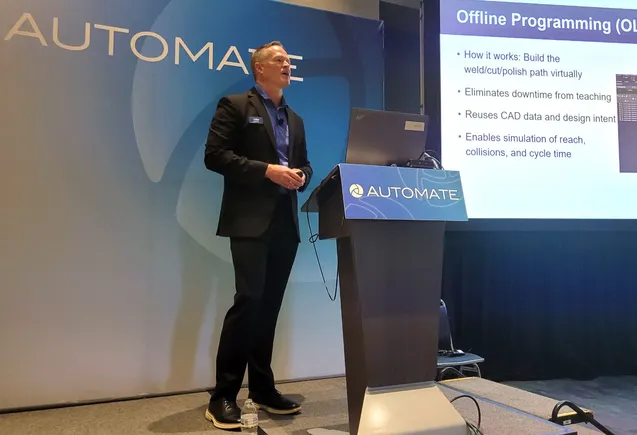
CHICAGO — Software evolutions are leading a shift from manual, code-driven collaborative robot programming to more intelligent, intuitive and user-friendly options, including sensor-laden and artificial intelligence-driven systems, according to speakers at the Automate conference in Chicago.
“Cobots have been huge. They’ve changed the industry the last few years,” said Josh Leath, senior product manager for thermal automation at Yaskawa Motoman, during a session on June 25. “AI is a big term. There’s lots that falls under that — whether it’s the machine learning side or broad learning side — bringing that down to the physical AI.”
Cobot suppliers are trying to expand into new markets while reaching maturity in existing ones, largely by leveraging new technologies and enhancing capabilities, according to Leath.
Historically, manufacturers had used cobots for repeatable, programmed tasks like painting or welding. Applications later expanded into assembly and logistics or warehousing.
Cobots increasingly are being used for inspection and quality control, Leath said. That underscores the expansion potential into applications where cameras, sensors and AI-enabled systems support real-time, dynamic adjustments to cobot operations.
While recent alterations to safety standardsspecifically ISO 10218 and ANSI/A3 R15.06have prompted a move away from the colloquial term “cobot” and toward the term “collaborative application,” the use cases and growth potential remain, according to Leath.
“I don’t think collaborative robots are going away, especially for the safety aspect,” he said. “That’s just going to evolve more and more. You’ll see collaborative robots … with more capability — and it’s coming very, very quickly.”
Just as uses and terminology for cobots have evolved, so have modes of programming and operating them.
“Everything’s kind of evolving around software now,” Leath said. This makes it easier to train cobots, such as with software in which they “observe” and mimic a human’s movements for a manufacturing task and then carry out that function going forward. Software iterations and AI tools also allow cobots to adapt to different real-world conditions and respond in real time.
“Just three years ago, this would have been impossible or extremely costly and complex,” Leath said. “AI is getting better and to the point with the new processors that we have.”
These evolutions also mean operators don’t need to teach a cobot how to work with all of a business’ different SKUs, because the adaptive capabilities allow them to work on similar parts with different SKUs.
In addition, more equipment manufacturers are adding cameras and force torque sensors so cobots can sense feedback and respond immediately. For instance, a cobot could spot variations in a weld seam and adapt the weld parameters and pattern as needed.
“AI, versus the cobot hand guiding that a lot of people are very keen to, adapts to on-the-fly part changes,” Leath said.
Suppliers generally are phasing out traditional hand-guiding pendants in favor of touchscreen options such as smart pendants or tablets, and the commands these devices understand are more intuitive than inputting specific coordinates, Leath said. Operators can “figure it out just using those more relative-type commands” that smart pendants enable.
Overall, hand guiding likely will end at some point in the future, Leath said. “That’s fine. It gets us to the next level.”
“Automation needs to be automatic. We want as little human intervention as possible,” he said. “Where we’re going to be in the future is beyond what we can really comprehend today.”