


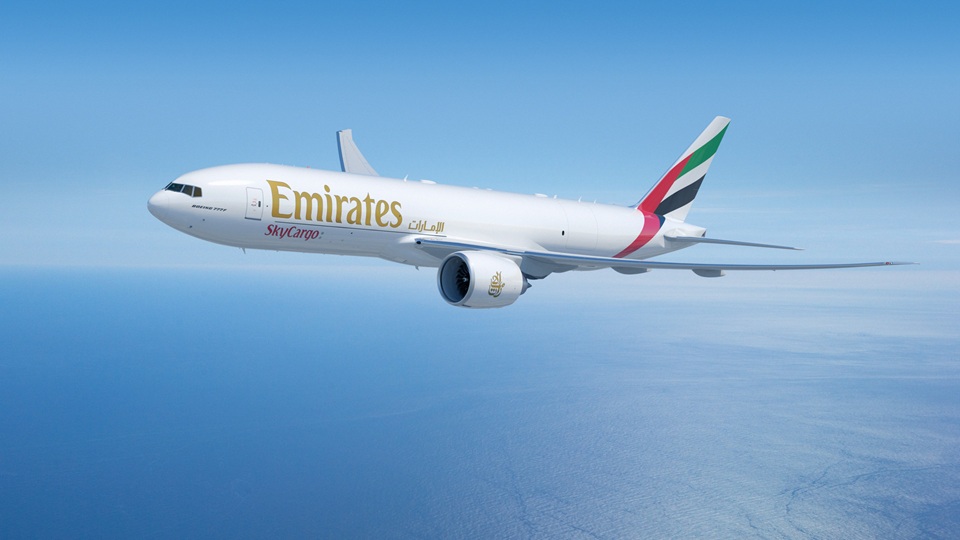
Emirates SkyCargo is planning to launch its first flights on the transpacific tradelane, while it will also soon end its passenger-freighter aircraft operations that were launched following the outbreak of the Iran-US conflict.
Speaking to Air Cargo News at the recent Air Cargo China exhibition, Nadeem Sultan, senior vice president, cargo planning and freighters, said that the carrier was expecting to enter the transpacific trade lane to capitalise on rising demand.
The service, which could launch this month, would operate on a round-the-world basis, starting in Dubai before going to Hanoi, Anchorage, Chicago, Europe and then back to Dubai.
In Europe, the service would likely call at either Schiphol or Frankfurt, he said.
“Demand is driven by a lot of general cargo but also, out of Vietnam, a lot of tech and electronics, whether it’s phones, AI industry-related hardware, laptops, all of that kind of demand,” said Sultan.
“Vietnam has become a massive production destination and that is driving a lot of this growth.”
The carrier has been rapidly expanding its freighter capacity in recent years and part of the need for extra aircraft is driven by the airline operating longer sectors, which absorb more capacity.
“These rotations are fairly long, so if you do two flights a week, that takes up a whole aircraft,” he said. “The average sector length that we used to operate is increasing quite a bit, so that is driving a lot of demand at our end.
“South America and North America are key in terms of growth over the coming years,” he added.
The airline has added a total of six Boeing 777F freighters to its fleet since March of this year, after taking delivery of its first converted 777 freighter in June.
In total, five more 777Fs are due to be delivered this year, including a second conversion, meaning by the end of the year the carrier’s freighter fleet will reach 23 777Fs (21 production and two converted) and the four wet-leased 747Fs.
Pax-freighter operation to end
Meanwhile, Sultan also confirmed that the airline’s passenger-freighter operation will likely come to an end in July.
The carrier launched the operation following the outbreak of the Middle East conflict when it had spare passenger aircraft as a result of lower tourist and business demand into the region.
However, the aircraft are now required for passenger flights as the conflict eases.
At its height, the passenger-freighter operation used 15 Boeing 777-300ERs, each offering capacity of around 65 tonnes.
“They have been utilised all over the world,” he said. “We have got flights going to South America, North America and the Far East.
“Our passenger operation today is around 91%, and by mid-July is expected to reach 100%, so by that time we expect to stop with the passenger-freighter operations, but by that time we would have taken delivery of a few more new freighters.”
He added: “2026 is a phenomenal year in terms of growth for SkyCargo in terms of capacity.”
Sultan said that the airline is already considering its capacity options after 2027 due to the strong demand levels, to meet the expansion of the passenger fleet and because Dubai is building a new airport that will be operational around 2032.
On the question of the airline’s plans for next-generation freighters, whether Emirates will order the Airbus A350F or the Boeing 777-8F, Sultan said the company is still considering its options.
“Both platforms are still an option,” he said. “To be honest, the delays that both platforms are experiencing have hampered our ability to make a decision.”
He added: “But we do hope, before the end of this year, to make a decision on that.”
He added that in the meantime, the converted freighters are perfectly timed to bridge the gap. Asked whether it is a concern that the orderbook for both models could continue to grow, Sultan said that Emirates could convert slots it has for the passenger models into freighter slots if necessary.
Demand outlook
Elsewhere, Sultan was positive about the demand outlook for the rest of the year.
“Because of the geopolitics and the disruption on the ocean freight side, that will continue to drive airfreight demand for the rest of this year. So 2026/27 is going to be a strong period for airfreight,” he said.
“This ocean freight disruption that we have seen, to iron it out, get the containers where they need to be to get the shipping lines to where they need to be again, that is going to be taking them a good few months, if not more, to get things back to normal.
“People are hedging their bets to an extent and just buying airfreight capacity to make sure they have a way to move their goods and then they will wait until the end of the year and next year to make long-term decisions on ocean freight.”
He also reiterated that the growth being experienced for technology, data centre and AI demand would continue to boost air cargo.