
Months of tariff-driven frontloading appear to have paid off for U.S. importers.
As expected, President Donald Trump on Friday reinstated broad-based tariffs on imports from 60 trading partners, replacing the temporary 10% global tariff that expired overnight with a new tariff regime under Section 301 of the Trade Act of 1974.
The move validates what retailers, manufacturers and other importers have been preparing for over the past several months: bringing cargo into the United States before the next round of trade barriers took effect.
The National Retail Federation (NRF) and Hackett Associates had already forecast an unusually early peak shipping season, projecting that July imports through the nation’s major container ports would reach a record 2.47 million TEUs as companies rushed to beat anticipated tariff increases, surpassing the previous monthly record set during the pandemic-driven import surge in May 2022.
“This year’s early peak season is expected to continue through July as retailers and other importers prepare for potentially higher tariffs and other trade uncertainties,” NRF Vice President for Supply Chain and Customs Policy Jonathan Gold said earlier this month when the forecast was released.
Hackett Associates founder Ben Hackett added: “Import volumes have risen sharply, with strong growth likely continuing into July. Much of this increase reflects frontloading ahead of expected tariff increases.”
That frontloading has been especially evident at the nation’s largest gateway for trans-Pacific trade.
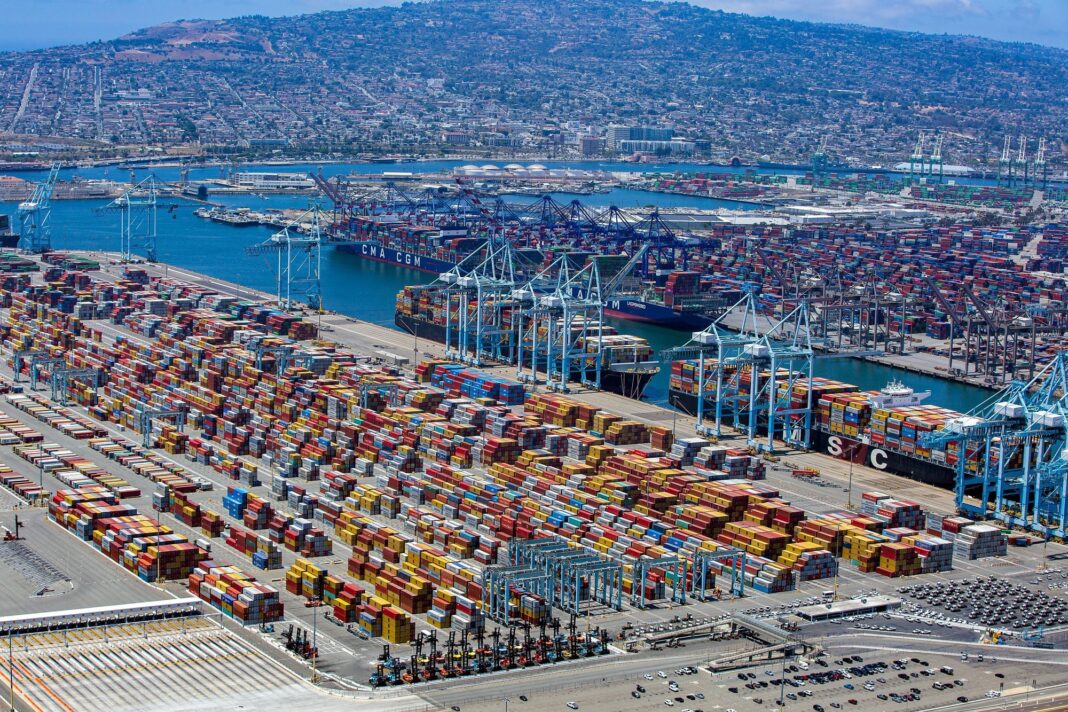
The Port of Los Angeles handled 1,002,734 TEUs in June, its busiest June on record and only the third month in the port’s history to exceed one million container units. Imports climbed 13% year-over-year to 530,558 TEUs, while total cargo volumes rose 12%.
Neighboring Long Beach also posted strong gains, processing 779,331 TEUs, up 10.6% from a year earlier. Imports increased 11% to 387,025 TEUs.
Port executives pointed squarely to tariff uncertainty as a key driver.
“Businesses are preparing for volatility, not certainty,” Port of Long Beach CEO Noel Hacegaba said during this week’s cargo briefing. “Retailers are intent on restocking shelves while keeping prices as low as possible, helping to drive the frontloading we’re seeing right now.”
Port of Los Angeles Executive Director Gene Seroka said importers have increasingly abandoned traditional seasonal shipping patterns, moving cargo whenever trade conditions create an opportunity.
Friday’s announcement suggests that opportunity has now narrowed.
The Trump administration’s new tariff program took effect at 12:01 a.m. EDT Friday, immediately replacing the temporary 10% tariff that had been in place since February after the U.S. Supreme Court struck down Trump’s earlier “reciprocal” tariffs.
The new duties, imposed under the more legally durable Section 301 authority, apply tariffs of 10% and 12.5% to goods from 60 trading partners covering 99.4% of U.S. imports, while exempting products including oil and gas, fertilizer, certain foods, aircraft and parts, critical minerals, and goods already subject to Section 232 tariffs. Goods already in transit are exempt through July 28.
Even as import volumes remain historically strong, the freight market is already showing signs that the early peak season is beginning to wind down.
The latest Drewry World Container Index fell 4% this week to $4,374 per 40-foot container, marking a second consecutive weekly decline as carriers deployed additional capacity into the trans-Pacific while demand began to ease.
Spot rates from Shanghai to Los Angeles fell 6% to $5,878 per FEU, while Shanghai-New York rates dropped 4% to $7,598 per FEU. Drewry attributed the declines to easing demand and increased vessel capacity, noting that carriers have reduced the number of blank sailings scheduled on the trans-Pacific next week from nine to six, widening the supply-demand balance.
Although the tariffs had been widely telegraphed, their implementation removes much of the uncertainty that prompted retailers to accelerate imports during the first half of the year.
Freight markets are already beginning to reflect that shift. Drewry expects trans-Pacific rates to remain stable next week, but said evolving U.S. tariff policy and geopolitical tensions in the Middle East—including emergency fuel surcharges announced by several carriers over concerns in the Strait of Hormuz—will continue to influence market conditions.
Whether cargo volumes remain elevated through the second half of the year now depends less on importers racing the tariff clock and more on underlying consumer demand. For the first half of 2026, however, the strategy has already delivered record cargo volumes at Southern California’s twin ports and what could become the busiest July on record for U.S. container imports.
Subscribe for Daily Maritime Insights
Sign up for gCaptain’s newsletter and never miss an update