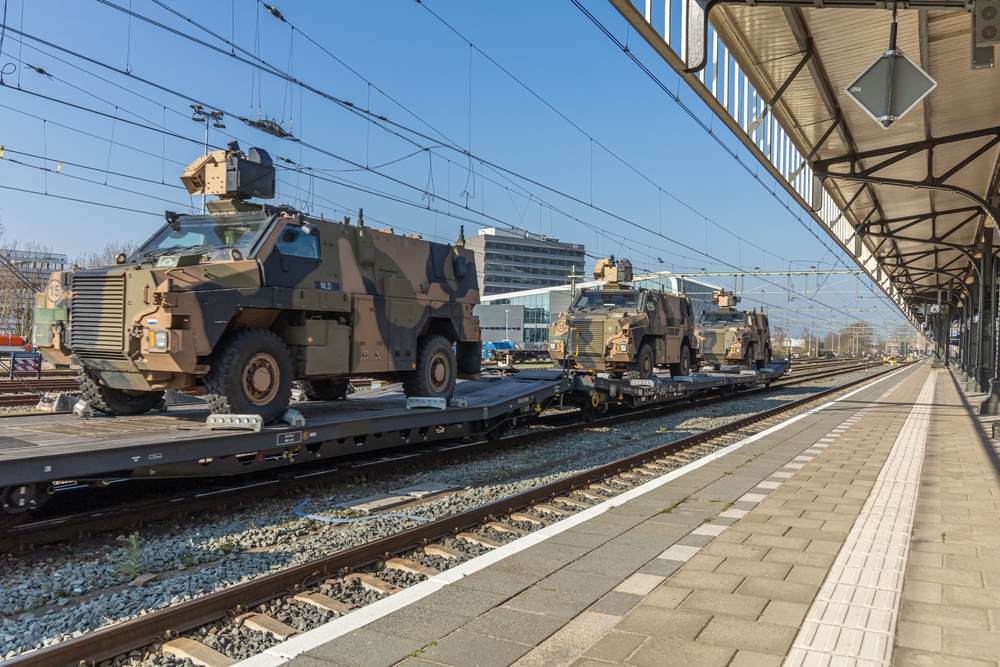

The EU is positioning its Military Mobility reform as a major boon for rail freight: better dual-use infrastructure, new defence-related contracts and sharper capacity allocation. But despite owning cross-border fleets that could be central to the system, rolling stock lessors say they have barely been involved in the talks. Carole Coune, Secretary General of AERRL, spoke to RailFreight.com about the package, the risks for the open rail market, and the role lessors want in Europe’s defensive turn.
Finding a seat at the table
Military mobility is about being efficient when running trains across borders. So we think we should be a key player in this area, but that has not been the case until now.
RF: The EU’s Military Mobility Regulation is moving quickly through the legislative process. The proposal aims to speed up cross-border military transport, but it could also have major implications for rail freight and rolling stock. How does AERRL read the direction of travel so far?
AERRL: To be very honest, AERRL has not been very involved in this topic until now. We answered the official consultations launched by the Commission, of course, and we are committed to helping the European institutions build the Solidarity Pool and the wider military mobility measures, which are very important for our continent. But up until now, we have not really been involved in official meetings. That is what we are asking for, because all the players need to be involved in this broad approach if we want to improve our readiness and preparedness for railway military mobility.
That seems surprising, given how central dual-use rail infrastructure is to the Military Mobility Package. Were you surprised that lessors have not been more involved?
Indeed. Leasing companies are major investors in modern rolling stock. Over the last ten years, we have ordered more than 40% of new locomotives in Europe, and mainly cross-border locomotives. Military mobility is about being efficient when running trains across borders. So we think we should be a key player in this area, but that has not been the case until now.
Looking at the draft legislation itself, do you see it as a positive framework for rail freight, or are the risks already becoming clearer as the text moves towards negotiations?
We hope this legislation can have a positive impact on all cross-border traffic, and in particular on freight traffic, which is currently suffering from the lack of capacity on European infrastructure. The dual use of infrastructure for commercial and military traffic can obviously help make cross-border traffic more efficient. It can increase Europe’s defence readiness, but it also has the potential to improve the Single European Railway Area more generally. We also hope it will mean better capacity management through the new regulation.
If the regulation is adopted broadly along the lines now being discussed, where would the biggest impact be for commercial rail freight and for rolling stock lessors?
There should be different objectives, different targets. One is capacity management, and the need to combine commercial and military traffic more effectively. If we can help build the Solidarity Pool, we should have a better picture of the remaining infrastructure capacity, and also a better view of the existing fleet available for commercial and military purposes.
It is also a question of continuing to build the Single European Railway Area. This process started more than 20 years ago, but we still see problems. Some states are concluding direct contracts with their state-owned companies for military mobility, and that shows a failure in the application of Single European Railway Area legislation. This is important for freight because new entrants now have a larger market share, which is one of the successes of the Single European Railway Area. But if military mobility is used as a reason to move back towards direct awards and state-owned incumbents, then we have to worry about the future of that market.
Interoperability is also key. Cross-border traffic is a question of interoperability, and military mobility is a good opportunity to focus on that. If trains stop at the border, how can we build a real defence policy? We need efficient cross-border traffic for both military and commercial reasons. That means we have to improve interoperability, mainly through ERTMS deployment. ERTMS can be accelerated, and should be accelerated, also for military reasons.

Interoperability and the ERTMS fix
If the EU talks with the lessors, it does not have a national approach anymore. It is talking with European partners.
How about on a day-to-day operational level? What would this regulation actually change for lessors and commercial freight? Could it mean more business, more funding?
Lessors are not primarily looking for public funding. They finance rolling stock themselves. If we need support for ERTMS, that is partly because ERTMS has to be updated too often and is deployed across Europe in a completely fragmented way. If we had one ERTMS, with a stable baseline, we would probably need much less financial support. The cost issue mainly comes from fragmentation.
What we are looking for is equal treatment between public state-owned companies, new entrants and rolling stock keepers. It is not always easy to be recognised as rolling stock keepers. This group of stakeholders is not recognised in the same way as railway undertakings in the regulation, but we have specific interests and we are major investors. We need to be recognised as such. Investors need predictability, stability and a place in the regulation, so that they can also express their view.
Let’s move to the Solidarity Pool. What does that mean for locomotive lessors, and how would it affect them if they were contracted to be involved?
We have said that we are committed to helping build this Solidarity Pool. The first step is to identify the best rolling stock for this kind of traffic, even before talking about the conditions. In our view, the first question is: what are we talking about? What is the best rolling stock? But until now, we have not been contacted by anybody. So we do not yet know what we are talking about in practical terms, and I do not think that first step has been taken yet.
From what I understand, the idea is to have a pool across different countries, but still organised largely through Member States. Where would lessors fit in that structure?
If the EU talks with the lessors, it does not have a national approach anymore. It is talking with European partners, because lessors have rolling stock running all over Europe and act as integrators. No lessor has activities focused only on one country. More than 60% of our locomotives are cross-border. This rolling stock is already ready to move through Europe, because it is already crossing Europe today; you switch from a national approach to a European approach. That is why we think we can be good partners.
The threat of protectionism
We are talking about a potential war… so we are all concerned by this crisis. Lessors are European companies as well. We are ready to commit as European companies, just like a Belgian, French or German company would…
Given that AERRL has not really been invited into many official discussions so far, do you feel that the EU is not yet viewing lessors as an important partner in military mobility? If so, could that still change?
The negotiations are still ongoing and we are still at the beginning of the process. We were concerned when we saw the contract in Poland (between PKP Cargo and the Polish Ministry of National Defence on military equipment transport), and that is why we published our paper. But I think it is still time to involve us, and to involve the new entrants in the freight and passenger markets as well.
You are referring to the recent Polish agreement, where state-owned PKP Cargo signed a military transport deal with the Ministry of Defence. Your concern is that this could become a model for giving military mobility work to state-owned incumbents. But from the outside, it seems understandable that a defence ministry might first turn to a state-backed company; the transport is sensitive and the command lines are clearer. What is the case for opening these contracts to private operators and lessors as well?
The argument is more or less the same as for commercial traffic or public passenger services. If you want to get the best value for money, you have to go through a tendering process. If you ask for a clearly defined service and receive offers, you can see which company can offer the best value for money. As long as you do not do that, you do not know whether the service you receive for a defined cost really offers the best value for money. You cannot know that if you go directly to one company.
I am not saying that we can do it for a lower price, but nobody can demonstrate the opposite either. If we want to take care of European citizens’ money, we have to check that the company chosen for these services can offer the best value for money.
We really have to consider (Military Mobility) as an opportunity, and try to find the best way to improve what has needed to be improved for a long time.
But are military and emergency contracts not different from normal commercial rail or public-service contracts? Cost matters, of course, but governments also want reliability, security and clear command lines in a crisis. Does that not make the case for state-backed companies stronger?
We are not talking about a war within Europe. We are talking about a potential war against countries outside Europe. So we are all concerned by this potential crisis. Lessors are European companies as well. We are ready to commit as European companies, just as a Belgian, French or German company would. We are ready to be as reliable as a national company, as we already do for commercial traffic.
There must also be operational advantages to using private lessors, given the investment many have made in cross-border locomotives. Is that part of the case for including them?
Yes, of course. These assets are reliable, modern and sustainable, and in many cases they perform better than national fleets. They should be considered, because they can bring real added value.
Looking ahead, there seem to be two sides to this for rail freight. Military mobility could bring better dual-use infrastructure, cross-border links and capacity allocation. But large defence-related contracts could also shift parts of the market towards state-backed incumbents. From the lessors’ perspective, how might this shape the rail freight industry over the next few years?
I think we should see military mobility as an opportunity to improve competitiveness within the European rail freight market. Take the question of priority for freight on European infrastructure. Military mobility could be a good opportunity to talk about that more openly, and maybe to change the position of freight compared with passenger traffic. As I said, we are more focused on the management of the assets. But if you want to be able to use the assets, you need infrastructure capacity. So this is also an opportunity to open debates that were considered closed in the past, such as priority.
It is also an opportunity for simplification. The simplification of the administrative aspects of rail transport regulation is already a topic for the European Commission, and this is linked to military mobility. We really have to consider it as an opportunity, and try to find the best way to improve what has needed to be improved for a long time.