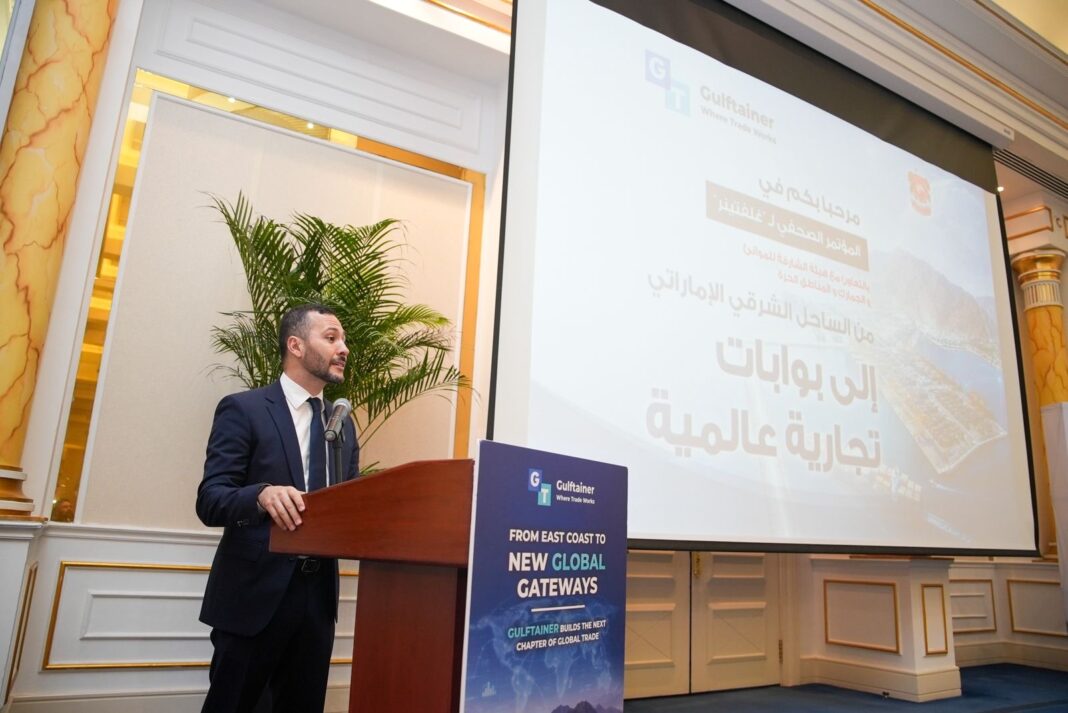

Gulftainer has announced the most significant transformation in its nearly 50-year history, unveiling a strategy to evolve from a global port operator into a fully integrated global trade infrastructure company.
The new direction brings together ports, shipping, inland logistics, industrial ecosystems and AI-powered supply chains into a single connected platform serving some of the world’s fastest-growing trade corridors across the UAE, the Indian Subcontinent, China, East Africa and the GCC.
The strategic shift responds to fundamental changes in global trade dynamics, including the regionalisation of supply chains, growing government investment in strategic economic partnerships and rising customer demand for resilient, end-to-end logistics solutions that combine physical infrastructure with digital intelligence.
At the centre of the strategy is the continued expansion of Khorfakkan Commercial Terminal from 3.5 million TEUs toward 5 million TEUs, with a long-term masterplan exceeding 10 million TEUs.
Future integration with Etihad Rail will transform KCT into a fully multimodal sea, road and rail gateway.
Complementing the port are Al Dhaid Logistics Park and Sajaa Logistics Park, together providing 2.3 million TEUs of annual inland logistics capacity encompassing warehousing, bonded and non-bonded storage, cold chain, contract logistics, container freight stations, distribution centres, e-commerce fulfilment, cross-docking, value-added logistics, light industrial activities and multimodal transport solutions.
GT Lines, currently operating 10 chartered vessels and expanding through owned vessel acquisitions, forms the maritime shipping pillar of the integrated platform, creating trade corridors that link ports, shipping and inland logistics across the region.
Gulftainer also positions itself as a key enabler of the India-Middle East Economic Corridor and the UAE’s role in China’s Belt and Road Initiative, translating government-to-government strategic partnerships into operational logistics connectivity.
Farid Belbouab, Group CEO of Gulftainer, described the announcement as the launch of a new chapter, asserting that the future of trade will be defined not by individual ports or isolated logistics assets but by connected ecosystems that seamlessly integrate maritime infrastructure, shipping, inland logistics, industrial development and digital intelligence into a single customer experience.