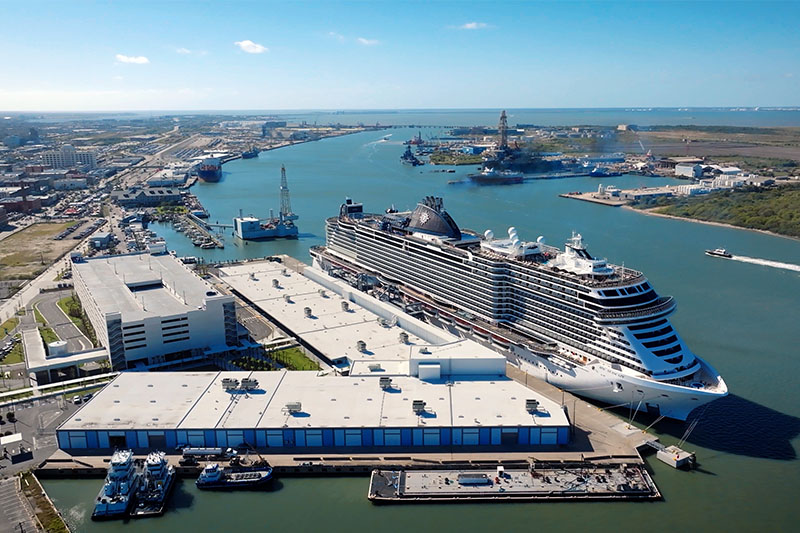

The Port of Galveston’s Cruise Terminal 16 has been recognized for meeting the standards for environmentally sustainable design, construction and operations with a Silver certification under the U.S. Green Building Council’s Leadership in Energy and Environmental Design (LEED) program.
Galveston Wharves Port Director and CEO Rodger said that this is the second cruise terminal at the port to earn LEED certification.
Cruise Terminal 10, home to Royal Caribbean Cruise Line, boasts LEED Gold certification, as well as LEED Zero Energy and LEED Zero Carbon certifications.
The port also announced that Green Marine, a voluntary environmental certification program for the maritime industry, recently recertified the port for environmental performance for the fifth consecutive year, reaffirming the port’s commitment to environmental stewardship and improvements in sustainable maritime operations.
Rees said, “We’re especially proud of this award because it’s another milestone in our progress as a Green Marine-certified port to improve air quality, reduce waste and take other steps to reduce environmental impacts on the waterfront.”
The port first achieved certification in 2021 and has maintained the rigorous environmental certification annually since then, the port said in a press release.
According to the Port of Galveston, the Cruise Terminal 16 embodies those same efforts. Opened in 2025, the terminal was developed with a focus on environmental responsibility, energy efficiency and long-term sustainability.
“Working with long-time port partners, architectural firm Bermello Ajamil & Partners and construction contractor Hensel Phelps, the port delivered a beautiful, environmentally sustainable cruise complex on time and on budget,” Rees said.
“It also allowed us to welcome two of the world’s major international cruise lines, MSC and Norwegian, giving our 46-million-person drive market two more great cruise vacation options. It meets cruise industry needs for future growth and the port’s mission of being a major economic engine,” he added.
Features include:
- Energy-efficient building systems
- Water-saving fixtures
- Environmentally responsible construction materials
- A reduced parking footprint
- Reduced outdoor lighting impacts, and
- Water-efficient landscaping.
By converting warehouses into a state-of-the-art 165,000-square-foot terminal, the project reused approximately 85 percent of existing structural elements, reducing materials consumption and other environmental impacts associated with new construction, the port highlighted.