

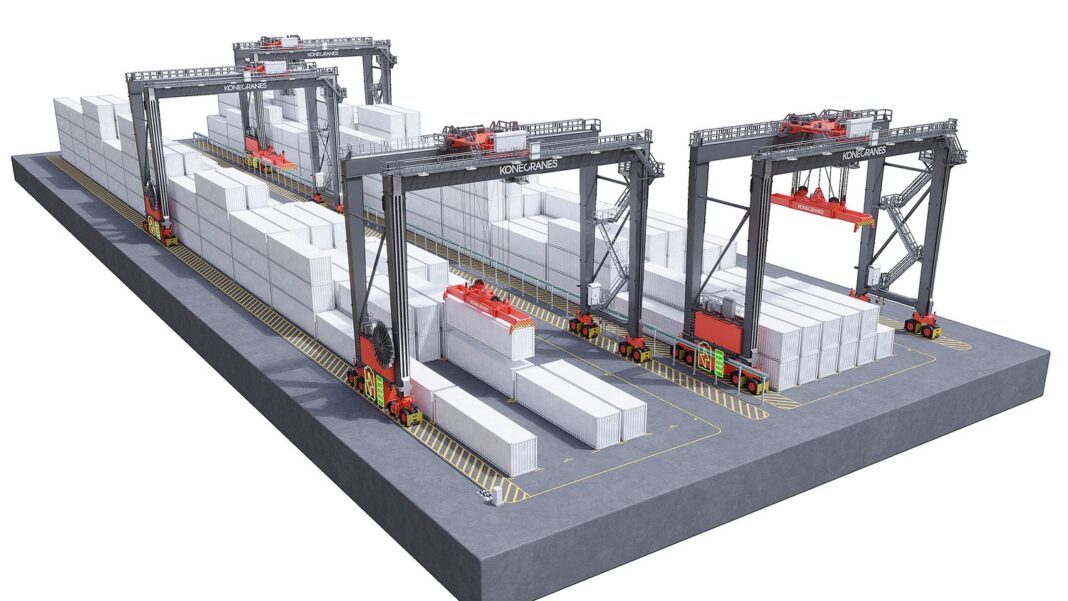

YILPORT Holding has ordered 53 E-Hybrid RTG cranes from Konecranes to support capacity expansion and emissions reduction across its global terminal portfolio.
The order, placed in the second quarter of 2026, will be delivered over the next two years and deployed across four terminals in Europe, Africa and Central America. Konecranes said that 10 automated E-Hybrid RTGs will be installed at Liscont Container Terminal in Portugal and 10 at Leixões Port in Portugal, while 18 RTGs at Acajutla Port in El Salvador and 15 at Takoradi Port in Ghana will be manually operated. All four locations are supported by Konecranes’ regional service organisations
Konecranes launched its E-Hybrid RTG in 2025, a machine that runs entirely on onboard batteries charged by grid electricity. Electricity from the grid is only used to charge the battery when needed, not to power the main functions of the crane directly. The E-Hybrid technology can be configured in different ways for fully electric operation with zero tailpipe emissions.
Container terminals can charge the E-Hybrid RTG batteries via a cable reel or busbar system during normal operations. The electrical power requirement for charging is 60 kilowatts, significantly lower than the 400 kilowatts typically required by RTGs powered directly through these systems. According to Konecranesthis allows for substantial capital expenditure savings when building or upgrading container yard infrastructure.
Investing in sustainability
“This agreement reflects YILPORT’s continuing strong growth and our long‑term vision of investing in efficient, sustainable and
“YILPORT is a valued global customer and a forward‑thinking terminal operator. We are very pleased to have been selected for this significant RTG delivery
Konecranes said that the E-Hybrid RTGs for Liscont Container Terminal and Leixões Port in Portugal will feature its Auto-Gantry system, enabling fully automated, unsupervised gantry operations alongside automated stacking. The agreement builds on previous Konecranes deliveries in 2025 to YILPORT’s terminals in Portugal and Sweden and reflects continued cooperation between the two companies in automated and lower-emission terminal equipment.