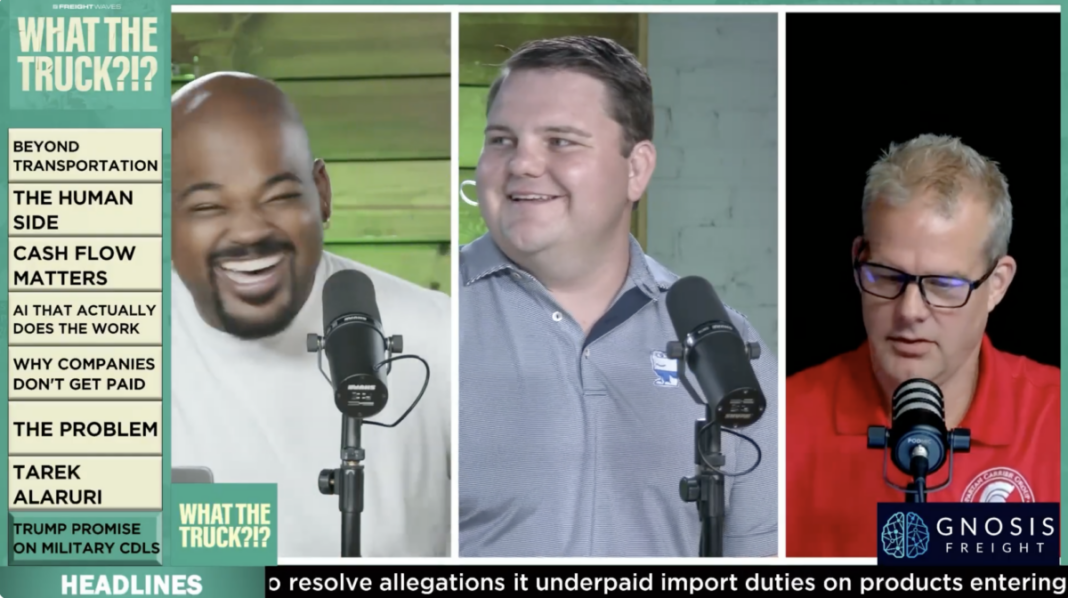

Tarek Alaruri has spent his career on both sides of freight’s money problem. First, chasing down loads as a broker, now helping shippers and carriers get paid faster. The CEO and cofounder of Stuut joined Malcolm Harris and Michael Vincent on FreightWaves’ “What the Truck?!?” podcast to talk about how his company is using AI to connect the entire order-to-cash process into a single workflow that, by his own account, has never existed in one place before.
Alaruri’s path into the AR space started at TQL, where he got his first look at freight brokerage from the inside.
“I did rather well there, but I really wanted the opportunity to try to fix something,” Alaruri said. That itch to fix something eventually became Stuut, his second company after an earlier venture called Fairmarkit that focused on freight quotations and bids.
But it was what he saw happening on the collections side that stuck with him. Alaruri estimated that a huge share of a brokerage’s back-office time gets swallowed by one issue.
“I think forty percent of our team’s time was spent chasing down invoices,” Alaruri said, “We had a single model: Did the customer pay us? Was there an issue? Did something in the docket get messed up? Was there a late fee?”
That inefficiency was strikingly analog for an industry that talks constantly about digitization. After spending enough time faxing paperwork to a shipper late at night, Alaruri knew there had to be a way to modernize some of those processes. He credits his time at TQL, working alongside CEO Kevin Kaley and the broader leadership team, with pushing him toward technology in the first place.
By 2024, Alaruri said, he was looking for what was next, and found that the receivables problem he’d identified years earlier still hadn’t been solved.
“Put yourself in the shoes of a broker or a carrier,” Alaruri said. “There are a lot of moving parts, a lot of paperwork, a lot of things that go on, and, you know, it’s not automated at all.” He described a workflow that’s still stitched together with manual steps even in supposedly digital systems. “There were a lot of items you still had to upload into a portal, and then you would have to take a copy, fax it over, and then mark it completed,” he said.
That gap, according to Alaruri, is why the space is ripe for disruption.
“No one’s really innovated on this process, even up to now,” Alaruri said. “Every company in the world needs to collect their money, and it’s a huge opportunity where our customers see a forty percent reduction in overdue invoices.”
While collections is the most visible symptom, Stuut built something broader than a bill-chasing tool. The platform is built to manage the full order-to-cash lifecycle, from assessing customer credit risk on the front end, through proactive customer communication, to resolving disputes and finally applying cash once it lands. Collections, in Alaruri’s view, is just the most painful piece of the process.
Now that AI hype is settling down, transportation and logistics companies are wondering whether or not AI can deliver on freeing up locked capital and removing the friction around verifying completed contracts.
The difference with AI today and previous technology fads, according to Alaruri, is that it can finally connect processes that used to live in separate silos.
“There are vertical specific solutions and there are point solutions, but they’re not encompassing a workflow,” Alaruri said. “At Stuut, we know that the way to really unlock this capital is to take these siloed datasets and close that loop. Did you get paid the right amount, and if not, how do you triage that and handle a dispute, and then how do you collect from a customer?”
Stuut works across multiple channels to unify those data points. The platform is built to manage the actual conversations companies have with their customers.
“The question was, how do we do that across the audio, SMS, and email or digital formats? That’s really what we focus on,” Alaruri said.
In effect, Stuut functions as a customer interaction layer, handling the outreach, reminders, and dispute resolution that used to require a person on the phone or drafting an email, all while keeping customer relationships intact with a personal touch.
The goal, according to Alaruri, isn’t to hand more tedious work to already-stretched finance teams. “Someone working in accounts receivable or at a brokerage doesn’t want to be doing this full time,” Alaruri said. “They just want to get paid and provide for their family. Even the people in finance want to start looking at their customers as a portfolio, not necessarily items to chase off a spreadsheet.”
Given the current anxiety around AI displacing jobs in logistics, Alaruri clarified that Stuut’s technology is not coming for accounts receivable roles.
“There are two edges of the coin, especially in this industry,” Alaruri said. “There’s the 3PL model where your broker is essentially doing this job. All we’re offering is to take off twenty percent of your time, so you can actually sell more.”
Alaruri is skeptical of the narrative of this technology replacing human roles. “I think that idea comes from a bunch of tech companies trying to sell their product,” he said. “In reality, there’s never been a major transformation or a platform shift that entirely cuts out people’s jobs. It really just enables them to do more.”
He compared it to a much older technology shift that nobody thinks of as a job-killer anymore: the advent of email.
According to Alaruri, AI’s role in accounts receivable simply frees finance professionals to focus on higher-value strategic work.
“Now, the professionals can focus on things like how to better insure freight and provide better service to carriers,” Alaruri said. “How do I take a look at my customer’s credit history and see how overexposed we should be? Where should we drive factoring decisions? Where should we actually view finance as a strategic transformation or a strategic pillar in the business? That’s really the goal of AI.”
Stuut’s platform pushes further into prevention than the traditional freight bill audit model, which historically has been built around finding money that already slipped through the cracks. Stuut sits on top of a company’s existing systems to catch issues early.
“Think about your emails, your billing systems, your TMSs, any type of calling systems you have, and then your bank accounts,” Alaruri said. “We can see issues before they happen.”
In other industries, that has meant nudging customers before they missed a payment so that they don’t lose services. Reminders and autopay have alleviated a lot of issues with subscriptions and payments.
Alurari translated that same logic back to freight. “Specifically in the freight industry, if you see that a customer is coming up on a credit limit, then we can flag internally that you want to stop overextending this customer,” he said.
Reaching people directly in the channel they’re most likely to respond to is the customer-facing side of Stuut’s platform. Simply flagging a problem for an internal team to chase down later leaves a lot of efficiency on the table.
Alaruri also described how the platform handles disputes automatically once it has proof of delivery data in hand. “We can see that the truck was late because we’re collecting the proof of delivery, and we’ll actually reach out, update it internally, and then resubmit it without a human being,” he said. “That’s where the efficiencies come from with our platform.”
Over the next five years, according to Alaruri, accounts receivable departments will be treating every invoice like a piece of data that has to be tracked from creation to cash.
“If you think about an invoice or an order as a token, using a blockchain analogy, the last step is that the token becomes physical cash in your bank account,” Alaruri said. “Our whole goal as a business is to use accounts receivable, because it’s the last step, and build our way up to help customers better sell things.”
Stuut aims to fill a gap that exists after a deal is technically won.
“You have Salesforce, you have a TMS, but everything after that just doesn’t exist in a platform today, and that’s what we wanted to build.”
The whole point, for Alaruri, is not to automate particular tasks, but to streamline the full set of conversations and decisions that lead to providers getting paid.
Click here to learn more about Stuut.
Brokerage Compliance Symposium
The day before F3. Every compliance issue you face – fraud exposure, carrier liability, FMCSA rules, cargo theft, insurance gaps – navigated by attorneys and operators defining best practices in a changing industry.
October 26, 2026
The Signal at Chattanooga Choo Choo • Chattanooga, TN
F3 Awards Dinner
The night before F3. FreightTech100 companies honored. FreightTech 25 and Shipper of Choice winners revealed live. Cocktail reception into dinner and live music – 300 industry leaders in one purpose-built room.
October 26, 2026
The Signal at Chattanooga Choo Choo • Chattanooga, TN
F3: Future of Freight Festival
Industry-defining keynotes, rapid-fire technology demos, and industry leaders networking in experiences across Chattanooga – plus the inaugural F3 Awards Dinner featuring the FreightTech and Shipper of Choice reveals.
October 27, 2026 – October 28, 2026
The Signal at Chattanooga Choo Choo • Chattanooga, TN
Compliance
Brokerage Compliance Symposium
The day before F3. Every compliance issue you face – fraud exposure, carrier liability, FMCSA rules, cargo theft, insurance gaps – navigated by attorneys and operators defining best practices in a changing industry.
The Signal at Chattanooga Choo Choo • Chattanooga, TN
Register Now
Awards
F3 Awards Dinner
The night before F3. FreightTech100 companies honored. FreightTech 25 and Shipper of Choice winners revealed live. Cocktail reception into dinner and live music – 300 industry leaders in one purpose-built room.
The Signal at Chattanooga Choo Choo • Chattanooga, TN
Register Now
FreightTech
F3: Future of Freight Festival
Industry-defining keynotes, rapid-fire technology demos, and industry leaders networking in experiences across Chattanooga – plus the inaugural F3 Awards Dinner featuring the FreightTech and Shipper of Choice reveals.
The Signal at Chattanooga Choo Choo • Chattanooga, TN
Register Now