
AI at Sea: From Connecting Vessels to Measurable Value
When artificial intelligence (AI) and digitalization are discussed in maritime, attention still gravitates toward autonomous ships. Yet the market is not about de-crewing but, rather, applying vessel and shore data to make operations safer,…
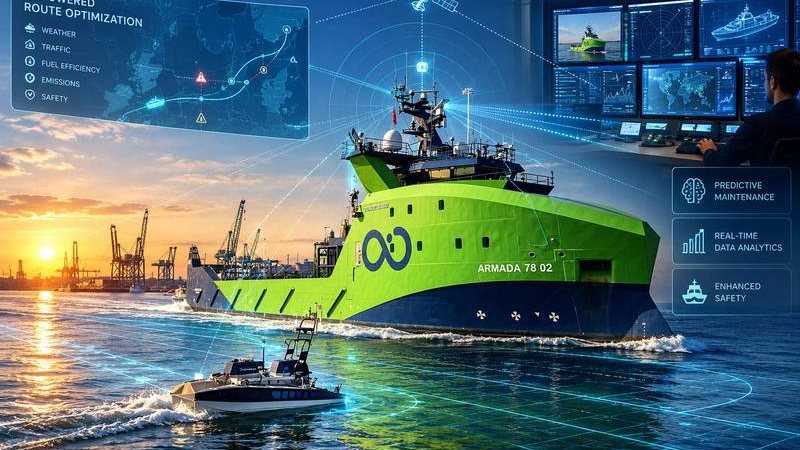
When artificial intelligence (AI) and digitalization are discussed in maritime, attention still gravitates toward autonomous ships. Yet the market is not about de-crewing but, rather, applying vessel and shore data to make operations safer, more fuel-efficient, and easier to maintain.
As of 2024, the maritime AI market stood at $4.13 billion, with a projected five-year CAGR of 23%. Market-size estimates should be treated cautiously, but the direction is hard to miss – AI solutions have advanced from trials into voyage planning, machinery monitoring, bridge decision support, port coordination, and digital assurance. The main questions are where it is producing measurable operational value and where the evidence still lags the marketing. The Vessel Has to Be Connected First
AI does not create useful ship data – it consumes it. The connected vessel is thus a prerequisite for the AI-capable vessel. Propulsion load, fuel flow, vibration, temperature, pressure, weather, satellite, radar, and camera data are collected through the Internet of Things (IoT) sensors and existing shipboard systems, aggregated and pre-processed onboard, and transmitted to shore via secure communications links.
Data quality and context set the ceiling on model performance. Sensor drift, missing values, inconsistent naming, and different operating profiles can affect the lab-tested solution reliability. Latency is another factor – any critical computer vision or machinery control cannot rely on continuous cloud connectivity, so the processing must happen on board.
This story was originally published by MarineLink. Read the full story at MarineLink →


Conversation