
BIMCO: Tanker shipping market overview & outlook
This year, tanker markets have been affected by disruption to transits through the Strait of Hormuz, the Houthi blockade of Saudi Arabian Red Sea exports, and attacks on Russian refineries and on ships in…
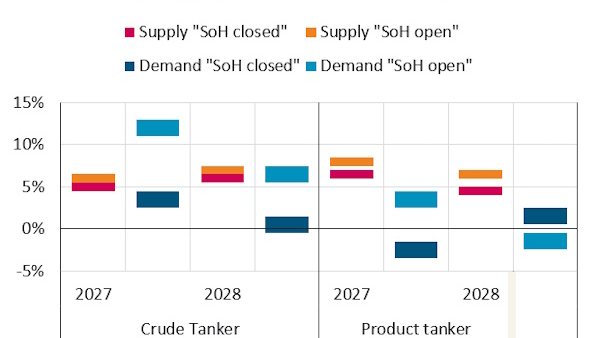
This year, tanker markets have been affected by disruption to transits through the Strait of Hormuz, the Houthi blockade of Saudi Arabian Red Sea exports, and attacks on Russian refineries and on ships in the Black Sea. As a result, year to date, crude oil and dirty-product cargo volumes are down 5% on last year, while clean-product cargo volumes are down 11%,” says Niels Rasmussen, Chief Shipping Analyst at BIMCO.
Since the start of the third quarter, however, ship-to-ship transfers in the Gulf of Oman from shuttles crossing the Strait of Hormuz have increased significantly. Over the past four weeks, Middle East tanker exports have reached 75% of pre-war levels, even though Saudi Arabian Red Sea exports have fallen since the Houthi blockade began.
Russian clean-product exports have meanwhile averaged 58% below last year’s level since the start of the third quarter, because of Ukrainian attacks on refineries.
“Despite lower volumes, risk premiums and reduced fleet efficiency have pushed freight rates to unprecedented levels. Rates have, however, recently weakened, and Platts S&P Global Energy’s Global Dirty Tanker Index and Global Clean Tanker Index are now 25%–30% below their October peaks,” says Rasmussen.
This story was originally published by Shipping Herald. Read the full story at Shipping Herald →

Conversation