
Design for Failure: Resilience, Risk, and Failure Modes
Resilience becomes expensive when it is treated as a shopping list of buffers: more inventory, more overflow space, more carrier capacity, more alternate lanes, more technology redundancy. A better starting point is diagnostic: how…
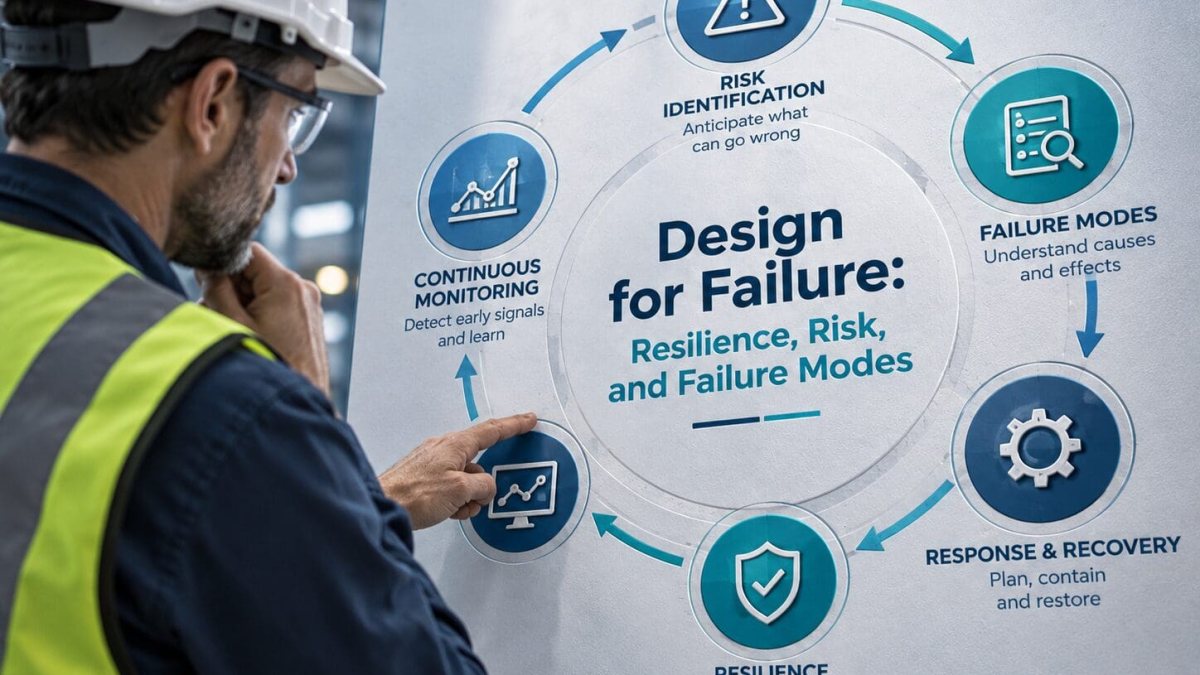
Resilience becomes expensive when it is treated as a shopping list of buffers: more inventory, more overflow space, more carrier capacity, more alternate lanes, more technology redundancy. A better starting point is diagnostic: how does this logistics system fail, how quickly will we know, and what happens next?
Systems engineering offers another useful discipline: failure mode thinking. Instead of beginning with the question, "How much redundancy should we add?" begin with, "How can this system fail, what happens when it does, and what should the system do next?" That produces a much more precise resilience strategy. Resilience becomes more important as the operation moves toward the Autonomous Logistics Network, because tightly connected and increasingly automated systems can propagate failures faster unless recovery paths are designed in advance.
A carrier can reject capacity. A port or terminal can close. A distribution center can lose power. A conveyor, sorter, robot fleet, or dock system can fail. Labor can become unavailable. A transportation lane can lose capacity. A software interface can fail. Data can be wrong. A cyber incident can isolate systems. An automated logistics decision can be incorrect.
The objective is not to imagine every possible disaster. It is to identify the failures that matter and understand their consequences.
This story was originally published by Logistics Viewpoints. Read the full story at Logistics Viewpoints →

Conversation