
Good Times Bad Times: The Premium Stays with the Strait
In October, we wrote that if the transfer network off Oman kept pace, Gulf crude would carry China’s refill and keep drawing tonnage east, supporting earnings on both routes. The relay largely kept pace.…
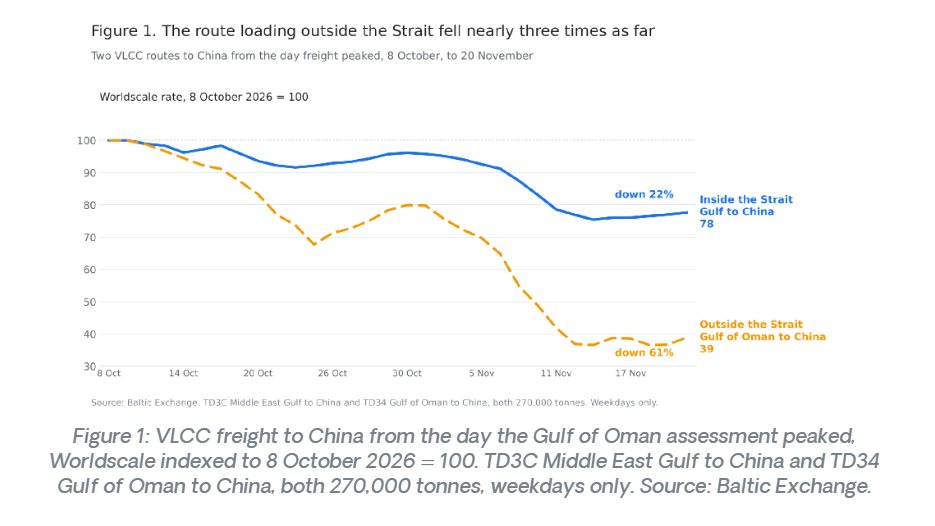
The cost of chartering a VLCC from the Gulf of Oman to China (TD34) reached 841 Worldscale on 8 October, the highest level since the route began to be assessed in March. By 20 November it stood at 328, down 61%. Over the same six weeks the run loading inside the Strait of Hormuz (TD3C) fell by 22% (Figure 1).
The obvious reading is that cargo abandoned loading outside the Strait and went back inside. Port and fixture data do not support it. The explanation is simpler. Freight outside the Strait fell with the rest of the VLCC market, and freight inside it did not, because it carries a premium for the transit itself.
Figure 1: VLCC freight to China from the day the Gulf of Oman assessment peaked, Worldscale indexed to 8 October 2026 = 100. TD3C Middle East Gulf to China and TD34 Gulf of Oman to China, both 270,000 tonnes, weekdays only. Source: Baltic Exchange.
Over the same six weeks, in Worldscale terms (lump sum for TD22), West Africa to China (TD15) fell by 60% and the US Gulf to China run (TD22) by 56%, both well away from the Gulf. The dividing line is not the length of the voyage, since the long haul Gulf to China run (TD3C) barely moved. It is the Hormuz transit. Of the four VLCC routes into China, only the one that crosses the Strait held most of its value, and the Gulf of Oman route fell with the routes from West Africa and the US Gulf.
This story was originally published by Hellenic Shipping News. Read the full story at Hellenic Shipping News →

Conversation