
Middle Corridor trains keep increasing amid persisting challenges
Freight trains connecting China and Europe via the Middle Corridor continue to experience massive growth, with their number on par to more than double in…
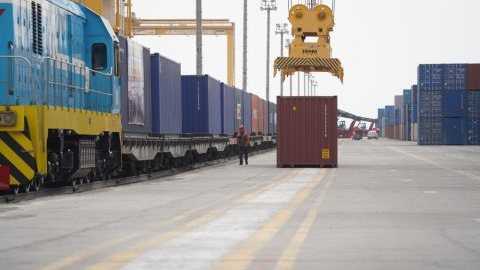
Freight trains connecting China and Europe via the Middle Corridor continue to experience massive growth, with their number on par to more than double in 2026 compared to last year. At the same time, there remain a few obstacles that might hinder further growth and fuel distrust among shippers. The number of trains running from China to Europe along the Middle Corridor reached 746 in the first nine months of this year, a 125% increase compared to the same period in 2025, according to Chinese media. A similar trend was confirmed by Kazakh Railways, albeit focussing on the first six months of the year. The company said that 419 convoys ran through the corridor, almost twice as much as the first half of 2025 (228 trains).
This massive growth is mostly linked to the fact that the Middle Corridor is a very recent initiative. The support it is gathering should not be underestimated, but the numbers show that it only carries a tiny fraction of all the China-Europe rail freight volumes. For example, at the current rate there will be roughly 1,000 trains running on the trans-Caspian route, while there were 1,965 trains between China and Europe only in May 2026.
In other words, the vast majority of shippers still relies on the routes going through Russia, which can guarantee much faster transit times. Sabina Asadova, Director of Regional Development for the CIS, Turkey, and Georgia at LV Logistics, told Azerbaijani media Media.az that moving cargo via the Middle Corridor currently takes 40 days, while via Russia it takes half the time.
This story was originally published by RailFreight.com. Read the full story at RailFreight.com →


Conversation