
Neoliner Origin marks first year in service
Nantes-based Neoline has reported fuel savings of 70 percent for its wind-powered ro-ro vessel Neoliner Origin in 2026, compared with a conventional fleet reference, despite technical issues limiting sail operations during its first year…
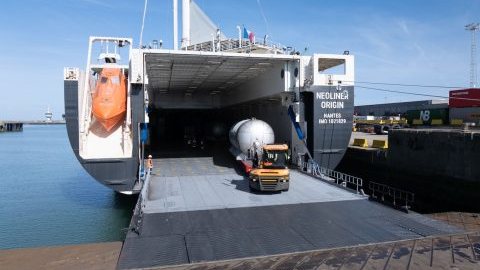
Nantes-based Neoline has reported fuel savings of 70 percent for its wind-powered ro-ro vessel Neoliner Origin in 2026, compared with a conventional fleet reference, despite technical issues limiting sail operations during its first year in service. The 136 m vessel, which entered service in October 2025, operates a transatlantic service connecting Montoir-de-Bretagne, Saint-Pierre-et-Miquelon, Baltimore and Halifax. Zeebrugge was added to the rotation in September 2026.
Since entering service, Neoliner Origin has completed nine commercial round trips, covering more than 62,000 nautical miles. It has transported 1,845 cargo units, equivalent to approximately 12,063 tonnes and 55,889 cu m of cargo, including vehicles, containers, out-of-gauge cargo, industrial machinery and refrigerated goods.
According to operator Neoline, the vessel saved 3,502 tonnes of fuel during its first year, representing a 66 percent reduction compared with the Global Logistics Emissions Council (GLEC) fleet reference. Savings increased to 70 percent when considering 2026 alone, with an estimated 11,228 tonnes of CO₂ emissions avoided over the full period.
Neoline also compared the vessel’s consumption with a simulated conventional ro-ro vessel operating on the same routes at 15 knots. This indicated fuel savings of between 62 percent and 67 percent on the voyages studied in 2026.
This story was originally published by Project Cargo Journal. Read the full story at Project Cargo Journal →



Conversation