
Scientists Discover Sunken Prehistoric Coral Atoll on Mid-Atlantic Ridge
Scientists on a 35-day expedition that concluded last month aboard Schmidt Ocean Institute’s research vessel Falkor (too) to the Romanche Fracture Zone in the equatorial mid-Atlantic discovered a 5-million-year-old sunken coral atoll, the top…
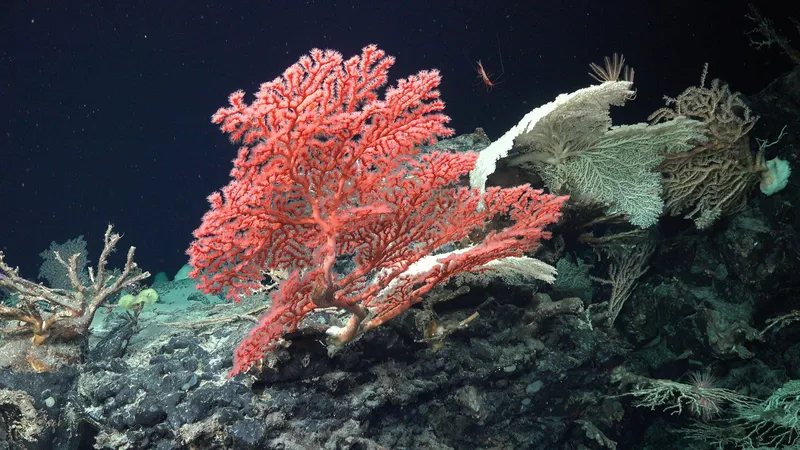
A community of cold-water corals and sponges thrives at a depth of 1,683 meters in the equatorial Atlantic Ocean’s Romanche Fracture Zone. Sessile, or immobile, organisms such as sponges and corals grow only millimeters per year and can live for centuries, with some corals documented during the expedition dating back 1,000 years. Across four distinct regions of the 950-kilometer transform fault, a Brazilian-led international science team captured the first visual evidence of ancient sponge garde
Scientists on a 35-day expedition that concluded last month aboard Schmidt Ocean Institute’s research vessel Falkor (too) to the Romanche Fracture Zone in the equatorial mid-Atlantic discovered a 5-million-year-old sunken coral atoll, the top of which is 900 meters below the sea surface. The finding confirms a 30-year-old hypothesis that there were once coral atolls in the middle of the Atlantic, a region where they do not exist today. A bustling deep-sea coral garden now sits atop the prehistoric atoll.
The Brazilian-led team also gathered the first visual evidence of dozens of thriving, vulnerable marine ecosystems in the fracture zone, an area long thought to harbor abundant deep-sea life. The team discovered ancient sponge gardens, 1,000-year-old cold-water corals, rare zoanthid meadows (an animal related to anemones and corals), and squids and octopuses across four distinct regions from depths ranging from 600 to 4,000 meters.
This story was originally published by MarineLink. Read the full story at MarineLink →

Conversation