
The US announces Middle Corridor commitment, but relies on private investment to develop it
During a visit to Uzbekistan, the US foreign minister Marco Rubio announced that the US intends to help develop the Middle Corridor. For Washington, the…
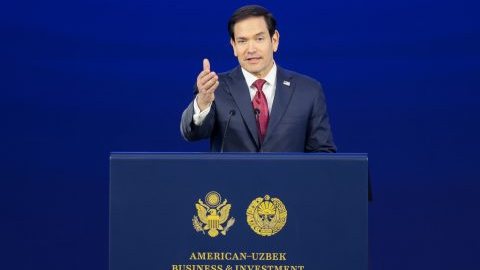
During a visit to Uzbekistan, the US foreign minister Marco Rubio announced that the US intends to help develop the Middle Corridor. For Washington, the matter is mostly one of competition: it wants to safeguard key supply chains amid fierce international strife. However, the US will not go so far as to commit significant funding to the corridor. Cooperation on the Middle Corridor will allow countries in Central Asia and the United States to secure the necessary resources, investment opportunities, and trade partnerships while maintaining sovereignty and independence and increasing shared prosperity, according to Rubio.
Logistics between Central Asia and the West depends on the Middle Corridor as a trade route alternative to routes through China and Russia. In order to develop it, Washington is pursuing a strategy of private investment. The only public money it has committed is a modest $201-million investment in the Trans-Caspian Enterprise Fund. By comparison: the World Bank has estimated the full Middle Corridor development will require some $25 billion.
The Trans-Caspian Enterprise Fund is designed to attract private money rather than pay for infrastructure itself. A US diplomat in Baku described its purpose as drawing private interest and investment into the corridor’s infrastructure, according to Trend.az.
For now, the US’ involvement in infrastructure is limited to TRIPP. This corridor will connect the two parts of Azerbaijan through Armenian territory. Armenia and the US jointly formed a company to develop the railway.
This story was originally published by RailFreight.com. Read the full story at RailFreight.com →


Conversation