
Tradlinx Report
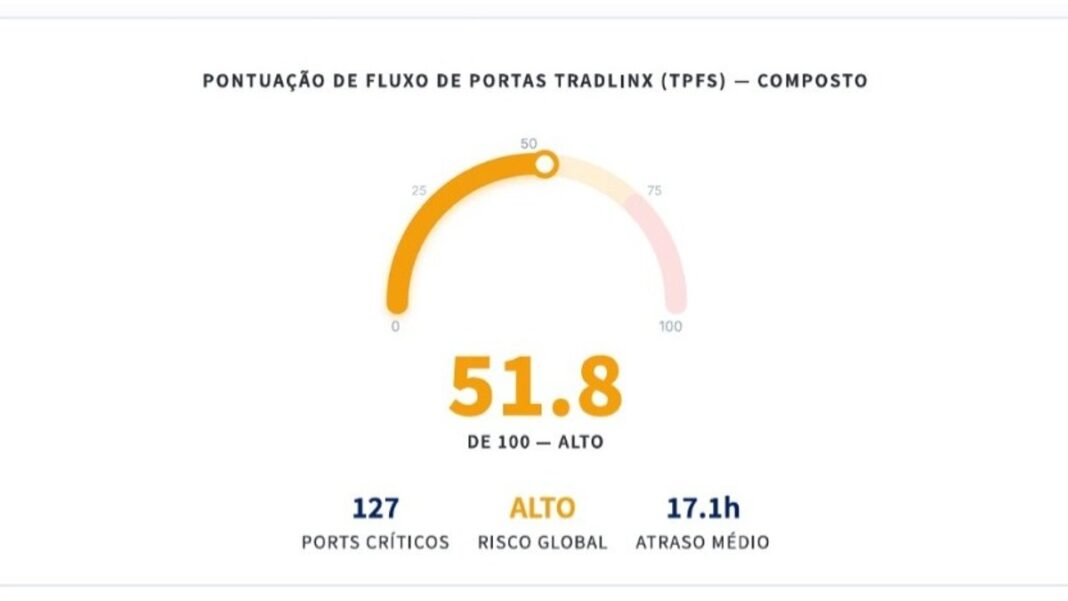
According to the most recent report from the South Korean platform Tradlinx, which monitors the operational performance of 1,253 maritime terminals in real time, the Global Port Congestion Index (PCI) reached the mark of 51.8 points in its composite flow assessment (TPFS), consolidating a scenario considered “High Risk”.
The survey, structured based on UNCTAD (UN) parameters and Queuing Theory (a branch of applied mathematics that uses probabilistic methods to study and optimize waiting lines), points out that the current logistical bottleneck is not limited to a localized event, but is severely distributed across strategic commercial routes.
Super Rectangle (728×90) – Position 17
While North America (15.5 points) and Northern Europe (31.8 points) maintain relatively healthy or moderate flows, regions such as Southeast Asia (61.6 points), Russia/CIS (59.1 points) and South Asia and the Middle East (53.5 points) operate under severe infrastructure stress.
The main negative highlight of the global report is the port of Guangzhou, in China, recently classified in the “Congested” category. The port complex recorded a significant delay in docking its ships, accumulating a moving average of 439.6 hours of waiting per vessel, equivalent to around 18.3 days in queue.
This jump represents an abrupt worsening of more than 435 hours compared to the previous two weeks (+12043%), creating the most severe structural bottleneck on the planet.
According to Tradlinx’s efficiency analysis, cargo ships arriving in Guangzhou spend an average of 95% of their total time at the port just waiting in the docking queue and only 5% doing the actual work of moving cargo.
Similar scenarios are also observed in South Manila, in the Philippines, with 122 hours of waiting (~5.1 days), followed by Central Manila (71.7 hours), also in the Philippines, Casablanca, in Morocco (38.9 hours) and Koper, in Slovenia (34.1 hours).