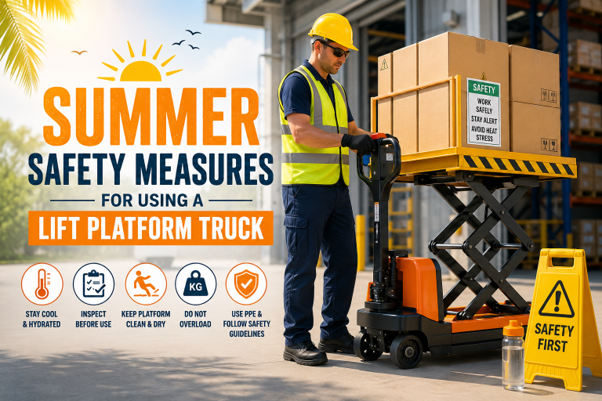

Summer allows you to spend more time outdoors. But this season may not be easy for some professionals, such as linemen. If you manage telecommunications cables or electrical lines, you may be aware of the season-specific challenges faced during work at height. Working around heavy equipment outdoors in high temperatures is never easy. It can be hazardous even when using equipment like a lift platform truck. UV rays, heat stress, and machine-related risks often worsen the situation. Whether you are an operator, a supervisor, or maintenance staff, you must follow proper summer safety measures when working at height on a boom lift.
Read also: The Crucial Role of Load Management in Forklift Operations
Managing Heat Stress on the Body
Operators can be vulnerable to heat exhaustion or stroke as temperatures rise. You should watch out for symptoms such as dizziness, fatigue, nausea, headache, confusion, palpitations, profuse sweating, and dry skin. As a preventive measure, you should keep yourself well hydrated. Make sure you drink enough fluids every 15 to 20 minutes. Don’t wait for thirst to set in. It is difficult to handle heat, especially when you are wearing rubber sleeves and gloves. Avoid working in peak temperatures between 1 pm and 4 pm. Stay in a shaded or air-conditioned area. Whenever possible, wear loose and breathable clothing. If you are new to the job, it is better to gradually increase your work time over one to two weeks gradually. Everyone in the crew should support each other. What should you do if someone suffers from heat stroke? The following steps can be helpful:
- Call the emergency helpline number.
- Move the person to a cooler space.
- Remove excess layers of clothing.
Protecting Equipment from Heat Damage
Heat can affect hydraulic systems. Due to rising temperatures, hydraulic fluid viscosity can change, reducing performance. That’s why you should inspect fluid levels and fluid quality. Check hoses and fittings for heat damage to prevent leaks. Tire pressure can increase under heat stress. You should check it daily to avoid blowouts. Rubber hoses and seals can become brittle or crack when exposed to UV radiation. These must be replaced when damaged. Insulating booms should undergo dielectric testing to ensure proper insulation performance.
Other Safety Considerations
Heat exhaustion is a real risk in the utility and construction fields. Hence, it is important to plan resources well. Staff rotation should be managed to limit exposure to high temperatures. Workers can wear cooling vests or take breaks under shade canopies. Everyone should remain alert when working at height. Since fire hazards can occur due to excess dryness and heat, some careful measures should be taken, including:
- Do not fuel hot equipment.
- Keep flammable liquids away from direct sunlight.
- Avoid accumulation of dirt and debris in the equipment parking area.
Summer is not just about heat and dryness. It also causes precipitation, storms, and lightning. Therefore, an emergency plan should be in place to address these situations. During thunderstorms, you should not operate a boom lift. Pause work for at least 30 minutes and resume only when conditions improve. Booms should be lowered during storms. Workers should not be near heavy equipment.
Nevertheless, equipment quality is another major factor. If the machine is not in good condition, it will not be safe to use, despite all the precautions. For help, you can view the inventory at https://www.bladeplatforms.com/.