
In dispatching, there’s a cruel joke when planning assets. It goes like this: the perfect route plan built at 6 a.m. rarely survives contact with 9 a.m. traffic, a sick driver, or a carrier that goes dark. HERE Technologies is betting the fix isn’t a better plan. Instead, it built a system that keeps learning from what actually happens after the plan leaves the office.
Bart Coppelmans of HERE Technologies walked FreightWaves through the company’s roadmap in an interview at Home Delivery World. In it, he covers upgrades to HERE’s tour planning engine, a newly launched driver feedback tool called Last Meter Guidance, and a prototype AI route optimization reasoning layer built to explain its decisions instead of just handing them down.
Tour planning is one of HERE’s oldest services, in development for a decade. New features are pushing adoption higher, Coppelmans said.
“We started developing this ten years ago, but it’s really picking up in the market now as one of the best performing solvers, especially because of what we added last year,” Coppelmans said.
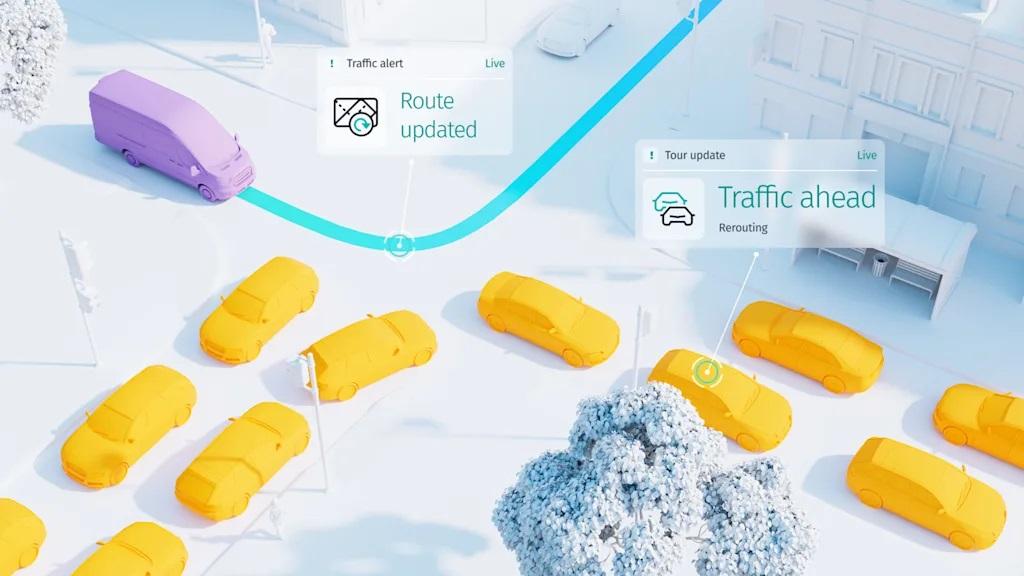
Chief among those additions is time-dependent optimization that accounts for how traffic changes delivery capacity throughout the day.
“At nine o’clock in the morning you can deliver fewer orders than at one o’clock in the afternoon because of traffic jams,” Coppelmans said.
HERE also added driver-friendly overlapping tours, which cut down on the territory conflicts drivers hate seeing on their routes, along with walk clustering, a feature that identifies when a driver should park once and deliver several stops on foot rather than repeatedly pulling in and out of a vehicle.
“From one parking spot you can then deliver by walking to multiple different deliveries in a certain area, which might be more efficient than driving in and out of your vehicle,” Coppelmans said.
Last Meter Guidance Closes the Loop
None of that solves the deeper problem Coppelmans wanted to discuss: the gap between what dispatch plans in the morning and what a driver actually encounters in the field.
“If you have a perfect plan by six in the morning, by nine it can already be different because of unexpected events — a driver getting sick, a carrier going dark or last-minute order changes,” Coppelmans said. “You need to be really dynamic and flexible, taking that into account.”
HERE’s answer is Last Meter Guidance, a client-side service that runs on a handheld device or driver app and collects sensor and positioning data from the field.
“We’re automatically collecting sensor and probe positioning points, we have our own positioning stack,” Coppelmans said. “This service builds on top of that, really making sure we’re learning from the field. We’re collecting traces data from where the vehicle is parking, the walk path toward the building, flagging the building entrance and the final delivery end-point location.”
That data flows in both directions. Dispatchers get more accurate delivery windows, and drivers get parking and entrance guidance built on where previous drivers actually succeeded, not just where a map thinks a building’s front door is.
“There’s no disconnect anymore,” Coppelmans said. “Drivers are more comfortable trusting what is being planned and can say, ‘Okay, this makes sense.’”
AI Route Optimization Learns to Explain Itself
Sitting on top of both services is what HERE refers to as a route optimization cognitive layer, a prototype agentic capability the company expects to move into closed beta later this year. Where the underlying tour planning API tells a dispatcher what to do, the reasoning layer is meant to tell them why.
“Why are these orders unassigned? Why are these two trucks going down the same street on the same day?” Coppelmans said. “It might be because of actual constraints, driving skills, or certain priorities.”
The layer doesn’t stop at explanation. It’s built to suggest fixes too, the kind of adjustments a veteran dispatcher makes on instinct.
“Maybe loosen certain constraints, move some orders to tomorrow, or add two vehicles into the capacity,” Coppelmans said. “That’s the domain-specific reasoning layer.”
Coppelmans compared the shift to what’s already happening in telematics, where fleets use generative AI to ask why a tire is losing pressure or why an asset went missing. Applied to dispatch, the same approach means a manager no longer has to intuit every downstream cause of a service failure.
“It gives you proactive responses in terms of what you can do to further improve your plan and make it even better,” Coppelmans said.
Grounding AI Before It Hallucinates
HERE paired the reasoning layer with a separate announcement: a location reasoning layer designed to keep large language models from making things up when asked about geography.
Ask a generic LLM to find a restaurant halfway along a truck route, Coppelmans said, and the results are often unreliable.
“If you now ask generic LLMs about a certain geo location, you get really random results, totally off, wrong geometry or wrong location,” Coppelmans said. “You get a wrong POI that isn’t nearby the river but somewhere else. You can get fooled easily, and these LLMs hallucinate based on geo-location queries.”
HERE Location Reasoning is meant to give agents the spatial grounding to answer those questions correctly, whether that means understanding where a vehicle sits on a road, drawing a boundary around a halfway point, or filtering points of interest that actually sit along the route.
“That’s the journey we’re on, further supporting different agents being built in the market,” Coppelmans said. “We’re feeding them with a correspondent layer so they can really understand the context of location and ground it.”
The Agent-to-Agent Future
Coppelmans doesn’t see the reasoning layer replacing a company’s own operational judgment. Every carrier’s KPIs and service-level agreements differ too much for one shared model to handle alone, he said.
“You need to have your own agentic operations agent running, but feeding that with learnings from others is super crucial, otherwise you’re siloed,” Coppelmans said.
The longer-term picture, he said, looks less like one company owning a single AI model and more like a network of agents querying each other, a carrier’s dispatch agent checking in with a routing agent the way a person might ask a colleague for a second opinion.
“You might think more in terms of agent-to-agent communications connecting certain things,” Coppelmans said. “It doesn’t necessarily have to be fully integrated into your own system, you can call different agents to pull other data sets to verify and qualify. But that’s not something we’re at yet, it’s a little bit further down the road.”