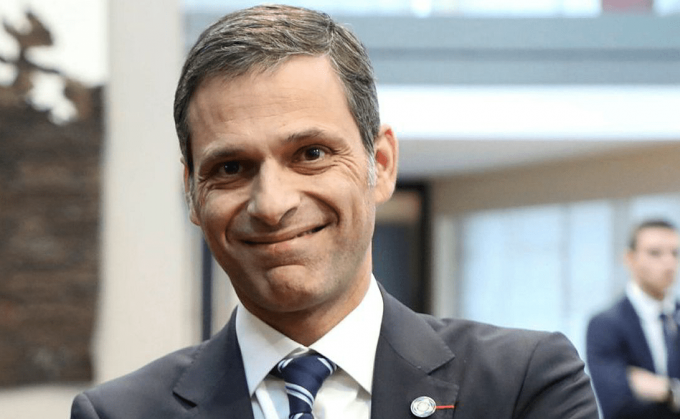

CMA CGM chairman and CEO Rodolphe Saadé has outlined how the French shipping giant is adapting to an increasingly fragmented trading environment, arguing that geopolitical instability is reshaping supply chains rather than bringing globalisation to an end.
In an interview with French business newspaper Les EchosMr Saadé discussed everything from the near-closure of the Strait of Hormuz and the Red Sea crisis to the group’s acquisition of FedEx Supply Chain, future fleet growth, and the role of logistics in reducing exposure to increasingly vulnerable maritime chokepoints.
The executive said the group remained confident enough in long-term trade growth to continue investing heavily in new vessels, despite concerns over future overcapacity.
“We are aiming to be number-two in the sector by the end of 2027, in terms of container shipping capacity.
“Will we be able to fill all these ships? I believe so, if only because the global economy continues to grow by 3% to 4% every year, with new markets developing. Moreover, we are not only investing in new vessels, but also in terminals and logistics. And if 2027 were to turn out to be a difficult year, following a positive one in 2026, we would scale back our operations.”
However, while dismissing speculation that CMA CGM could join any wave of consolidation among container lines, he made clear that acquisitions would remain focused elsewhere.
Asked whether the carrier was interested in buying other shipping companies, amid reports MSC could pursue Hapag-Lloyd, Mr Saadé replied: “We’re happy with what we have. We’ll continue to grow organically in shipping. It’s in logistics that we’re making acquisitions.”
That strategy was reinforced by the recently announced $1.4bn acquisition of FedEx Supply Chain, which Mr Saadé described as “considerably broader” than a warehousing transaction.
“Since the acquisition of Ceva six years ago, the CMA CGM group has continued to grow this business. The logistics division accounts for around 40% of the group’s total turnover, compared with 60% for maritime transport. My wish is to continue developing the logistics business, which is less cyclical than maritime transport.”
He said the agreement extended beyond the acquisition itself to long-term commercial partnerships covering ocean freight, air cargo, and contract logistics.
“It’s a genuine strategic partnership, covering all the group’s core businesses. In the maritime sector, FedEx manages around 74,000 containers for a variety of clients. The idea is for us to become its preferred carrier. Finally, we are forming a partnership in air freight, involving the exchange of capacity.”
Since 2022, CMA CGM has been building its own air cargo operation and has ordered eight A350 freighters, due for delivery from late 2027, as e-commerce continues to support demand.
“The partnership with FedEx as a whole is worth around $5bn,” he added.
Mr Saadé also highlighted the continued importance of the US market, which now accounts for around a quarter of CMA CGM’s turnover.
“We will continue to expand in the US, as we did earlier this year through our partnership with US investment fund Stonepeak, which enables us to strengthen our investment in terminals.
“By strengthening our presence in the region, we are helping to streamline the flow of goods, bring stock closer to consumers, and reduce certain bottlenecks. At a time when securing supply chains is becoming a strategic asset, this operation is helping to build more robust and efficient supply chains.”
Current market conditions, he added, continued to reflect geopolitical uncertainty. While oil prices have fallen significantly from their peaks, insurance costs remain elevated following the recent crisis around the Strait of Hormuz.
“One factor driving up demand is the earlier-than-usual peak season, because our customers, faced with uncertainty, are already looking to ship Christmas goods from Asia to Europe, the Americas, and Africa. They are also concerned about the possibility of new US tariffs on Chinese goods at the end of the year.”
Although traffic has partially resumed through Hormuz, Mr Saadé said the carrier remained firmly in crisis management mode.
The group still has crews aboard nine vessels stranded in the Persian Gulf, although the CMA CGM Galapagos successfully transited the strait at the end of June.
“I hope to see an improvement in the situation in the coming days, but I believe it will take several months to return to normal operations. Until the strait is effectively reopened and we have ensured the safe exit of all our ships, we remain in crisis management mode.
“As for the question of a toll, I do not think that is a good idea. Global trade relies on freedom of movement. If we start imposing a toll at Hormuz, then why not tomorrow at Gibraltar, or at other ‘strategic’ straits?”
He argued that the disruption demonstrated the need to build greater resilience into global supply chains.
“We can no longer rely on a single transit point. We must organise alternatives. This involves intermodal solutions: unloading in Oman or Jeddah, then transporting the goods by truck. If Hormuz is open, we use it. If it isn’t, we must be able to offer our customers other options. That is why we are investing at the port of Sohar in Oman.”
Despite growing geopolitical tensions, Mr Saadé rejected suggestions that globalisation was in retreat.
“The major trade flows between Asia, Europe, and the US remain fundamental, while co-existing with increasingly significant regional trade. Geopolitics does not put an end to global trade; it simply forces those in the transport and logistics sectors to be much more resilient, flexible, and diversified.”
He added that around 60% of CMA CGM’s fleet had now returned to transiting the Suez Canal, with the remainder still sailing around the Cape of Good Hope because of the continued threat posed by Houthi attacks in the Red Sea.
“Wherever possible, we prioritise the most direct routes. However, when certain straits become too risky or impassable, the detour becomes necessary – significantly lengthening journey times, increasing operating costs and disrupting rotations.”
This article is © The Loadstar. Reproduction, rewriting, or derivative use requires a license. Contact [email protected] for licensing enquiries.