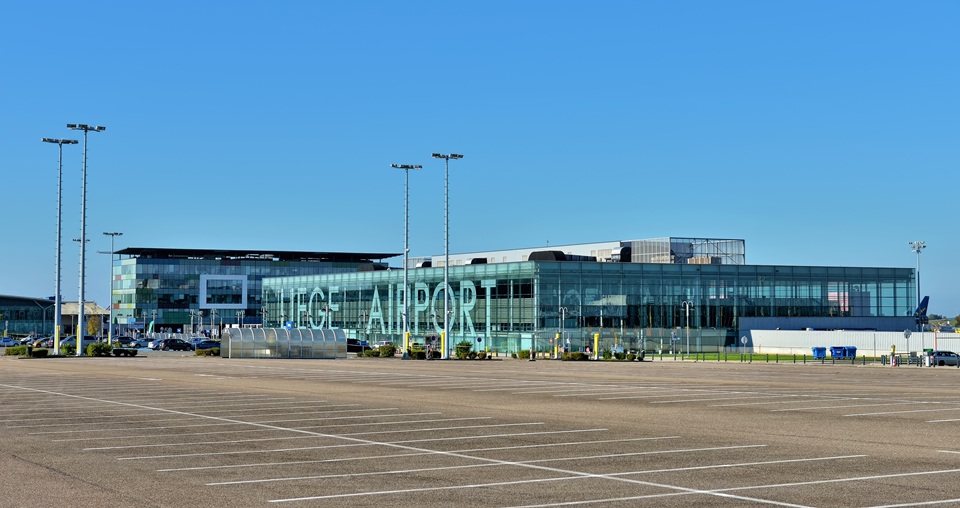

Belgian cargo hub Liege has continued to report strong improvements in its cargo volumes in the first half of the year thanks to growth in export volumes but it warns that new e-commerce rules could have a negative impact in the short term.
Over the first six months of the year, the Belgian hub saw its air cargo volumes increase by 11.3% year on year to 697,816 tons, while the number of cargo movements was up by a lower amount of 3.3% to 14,354.
The airport said that one of the reasons for volumes increasing faster than the number of flights, was a rise in export cargo out of Europe, while efficiency gains also boosted performance, the airport claimed.
Volumes exported via Liege Airport increased by 19% compared to last year, compared to a 6% growth in imports, “reflecting the dynamism of European companies that use the airport as a logistics platform to global markets”.
The increase in exports was concentrated to Asia where volumes were up 17% and North America where there was a 51% improvement compared with a year earlier.
The growth differential was particularly exacerbated in the second quarter of 2026 with growth of 18% for exports and less than 1% for imports compared to 2025.
However, the rate of growth in the tonnages handled slowed in the second quarter to 7.5% compared with 15.6% in the first quarter.
Frédéric Brun, vice president of sales and marketing at Liege Airport, said: “The increase in tonnages, which is much higher than that of movements, illustrates the efficiency gains made by the entire airport ecosystem. The strong growth in exports is also a very positive signal for Liege Airport.
“In a turbulent international context marked by the reconfiguration of supply chains and the continued growth of e-commerce, Liege Airport confirms its strategic role at the heart of European and global trade.”
E-commerce rules
However, while the year has started strongly, the airport warned that a new €3 per item charge for e-commerce imports introduced by the European Union on 1 July could take its toll in the second half.
“As has been seen in other countries following the introduction of similar measures, it is expected to have a negative impact on air cargo volumes in the short term,” the airport said.
“This new legislation and similar changes to come could lead to a change in supply chains, with a modal shift from air to sea transport and the multiplication of distribution and fulfilment centres on European soil.
“Liege Airport is following this development closely and it is far too early at this stage to draw conclusions.”
Early figures from consultant Rotate suggest that European freighter capacity declined at the start of the month, potentially as a result of the legislation.
The charge is likely to be followed later in the year by a separate €2 processing fee, expected in November 2026.
Some EU member states are already introducing their own local fees and requirements in parallel with the EU-wide reform. The countries that have introduced the extra charge have reportedly seen volumes shift to airports in other nearby countries.