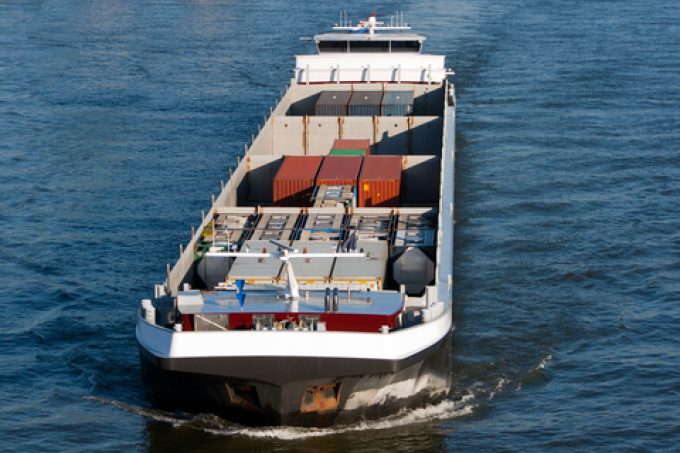

Rhine barge. Photo: © VanderWolfImages Dreamstime.com
North Europe’s inland transport sector could grind to a halt after water levels along the Rhine sink to a point at which navigation is all but impossible, forcing volumes onto an already stretched and insufficient rail and road network.
Sources warned The Loadstar over the weekend that all four depth gauges on the Rhine were set to fall below navigable levels amid a European heatwave that has resulted in drought.
Indeed, barge operator Contargo confirmed this morning that levels at the Kaub gauge were 53cm – 8cm below the level at which barge operators will accept cargo with a low-water surcharge (LWS) of €120 per teu, or €165 per 40ft.
LWSs have been in effect across all four gauges, but from today, operators will only move volumes on the Cologne and Kaub stretches by agreement – “it has come to a standstill,” one source told The Loadstar.
Another source added: “This will have serious impact on all modalities. Road is still suffering under the Oosterweel project, causing extreme congestion around Antwerp. But with the reduced capacity brought about by low water levels on not only the Rhine but also the Meuse and Waal limiting the draught of inland vessels, we are seeing a huge increase in the levels of freight aiming to move by road.”
With extra trucks headed for terminals in Antwerp and Rotterdam, The Loadstar was told there was significant congestion on the R1, E313, E34 ,and A12 roads, close to Antwerp, and that terminals had already exceeded storage capacity.
This, a barge owner told The Loadstarmeant the rule for inland barges at Antwerp was that,”if you want to drop a container than you have to take one”, the owner adding that those who do, need to expect waits on box ships of 32-44 hours, with 72-hoiur delays in inland navigation.
They added: “Rail can absorb some of the inland waterway traffic, but capacity is limited, with Antwerp filling up quicker, meaning planning becomes more complex leading to more shunting manoeuvres and local traffic congestion around rail hubs.”
Sources warn that serious rainfall will be required to get water levels “back to where they need to be”. The Cologne gauge will need to climb 8cm, from its present 98cm, to 106cm before barge operators will accept cargo – under an LWS of €100 per teu and €120 per 40ft – while it would need a 100cm rise to get to the point where LWSs would be removed.
Barge owners said those able to find space on barges should recognise that the vessels would be carrying anywhere from 20% to 60% less cargo than usual.