
Switching an autonomous vehicle’s software from one truck to another has always cost the industry time. It takes things like engineering work, new data collection and retraining. Waabi recently announced that it made that process disappear entirely.
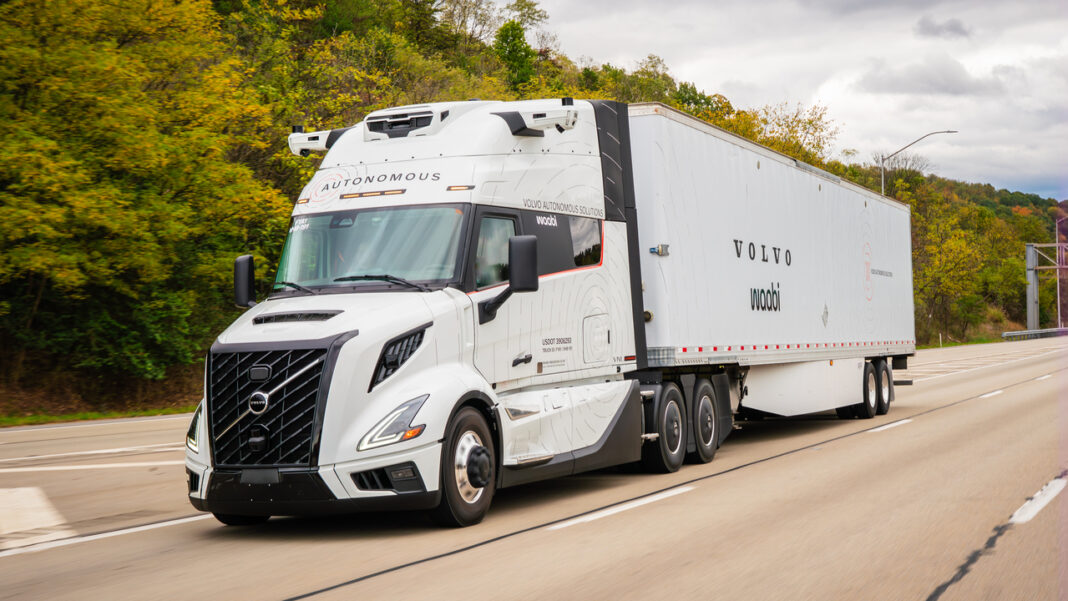
The self-driving company announced in a blog post that its Waabi Driver software, trained exclusively on a Peterbilt 579, took control of a Volvo VNL Autonomous truck and drove it safely on highways and complex surface streets from the very first mile. No new real-world data. No simulation data. No fine-tuning. No engineering work.
“This was a massive announcement, Thomas. It was massive for Waabi, but for the industry and Physical AI in general,” Waabi founder and CEO Raquel Urtasun said in an interview with FreightWaves.
To prove the Waabi Driver’s ability to generalize in this way, Waabi collaborated with partner Volvo Autonomous Solutions to integrate the Waabi Driver onto the Volvo VNL Autonomous. Before this, the Waabi Driver was used to driving a Peterbilt 579. The
two trucks couldn’t be more different. Sensor placement, vehicle shape, and control systems all vary between the Peterbilt 579 and the Volvo VNL Autonomous.
“The sensors are in very different locations. The shape of the truck is very different. The way you control the Volvo VNL is also very different, and it feels very different from driving a Peterbilt,” Urtasun said. “Yet we required zero changes. It was directly plug-and-play. Same stack. Same model. Same everything.”
The Volvo VNL Autonomous handled lane changes, traffic lights, right turns, three-way intersections, and U-turns on its first outing with the new software, according to Waabi.
Historically, that kind of platform switch has been one of the toughest problems in autonomous driving.
“Up to this point, whenever anyone in the industry wanted to move from one vehicle platform to another, it typically required more than a year of engineering work,” Urtasun said. “‘Quickly’ was actually zero. The system generalized without needing anything. You really break the physics of what everyone believed was possible.”
Nils Jaeger, president of Volvo Autonomous Solutions, called the road test “an important proof point of our partnership with Waabi” in a statement.
“It also demonstrates the scalability of Volvo’s autonomous truck platform, which is designed to integrate different vehicle models and virtual drivers to enable a wide range of use cases and applications,” Jaeger said. “Together with Waabi, we are advancing autonomous transport solutions toward commercial reality.”
Why Autonomous Truck Generalization Matters for Scaling
For carriers and OEMs, the practical upside is speed. Waabi describes two kinds of generalization that matter for scaling: across environments, meaning highways to dense urban streets, and across embodiments, meaning entirely different vehicles. The Volvo test proved the second.
Urtasun said the capability extends beyond trucking, to vehicle classes and to sensor hardware itself.
“The same applies across different vehicle classes. Today we do Class 8 trucks. Maybe tomorrow you want a solution that can do Class 5, Class 6, robotaxis, whatever it is,” Urtasun said. “If a new sensor comes to market that’s significantly more capable or much cheaper, you want to be able to take advantage of it immediately.”
AV providers have told FreightWaves that switching sensor suites is a persistent pain point, forcing them to retrain their systems, sometimes repeatedly, as new hardware arrives. Waabi argues that dependency disappears once a single model generalizes across platforms and sensor suites.
Reasoning Over Raw Compute
Urtasun credited the result to Waabi’s underlying architecture, which she contrasted with rivals betting on scale alone.
“If you look at previous generations of AI technology, version 1.0 was built around handcrafted programming. Those systems don’t generalize at all,” Urtasun said. “Then came this black-box architecture where the answer became more data, more chips, bigger data centers. You see some of the players investing billions into that approach.”
Waabi built something different, she said: a system that interprets what it perceives, reasons about it, evaluates possible actions and their consequences, then chooses a maneuver. It’s closer to how a human brain works.
“This type of architecture is the first one that’s able to demonstrate those capabilities,” Urtasun said. “Only Waabi has this technology.”
Waabi’s simulation platform, Waabi World, helped build the underlying Waabi Driver system, but Urtasun said the Volvo test itself required none of it.
“We didn’t even need simulation,” she said. “This announcement is really about this next generation, AV 2.0. It’s about the autonomy system itself.”
One Brain, Every Vehicle
Urtasun framed the embodiment breakthrough as a preview of Waabi’s robotaxi ambitions, which she described as the company’s “second embodiment.”
“It’s a shared brain that drives everything. Whether it’s the Peterbilt. Whether it’s the Volvo VNL. Whether it’s a robotaxi. It doesn’t matter,” Urtasun said. “Everything you do in one vertical improves every other vertical. The cost stays the same because it’s the same brain.”
She argued Waabi’s highway experience and more than a year and a half of door-to-door trucking operations give it an edge robotaxi developers lack.
“One thing competitors struggle with is highways,” Urtasun said. “We excel on highways. We drive trucks that have to see farther and plan much more proactively. Those capabilities are already there. We also already have the capabilities required for cities because we’re driving on surface streets today.”
Commercialization, not new capability development, is now the bottleneck, according to Urtasun.
“Out of the box, it’s super performant. It blew the minds of everybody, including our partners,” she said. “From there, it’s really up to the races in terms of commercialization and scale.”
Waabi has not compromised safety standards to get there, Urtasun said, noting the company’s driverless launch will run on a fully validated OEM platform.
“Driverless is almost here,” she said. “The future of self-driving is truly here.”