Agreement between Mercosur and the European Union is made official and comes into force on May 1st
Ricardo Stuckert / PR
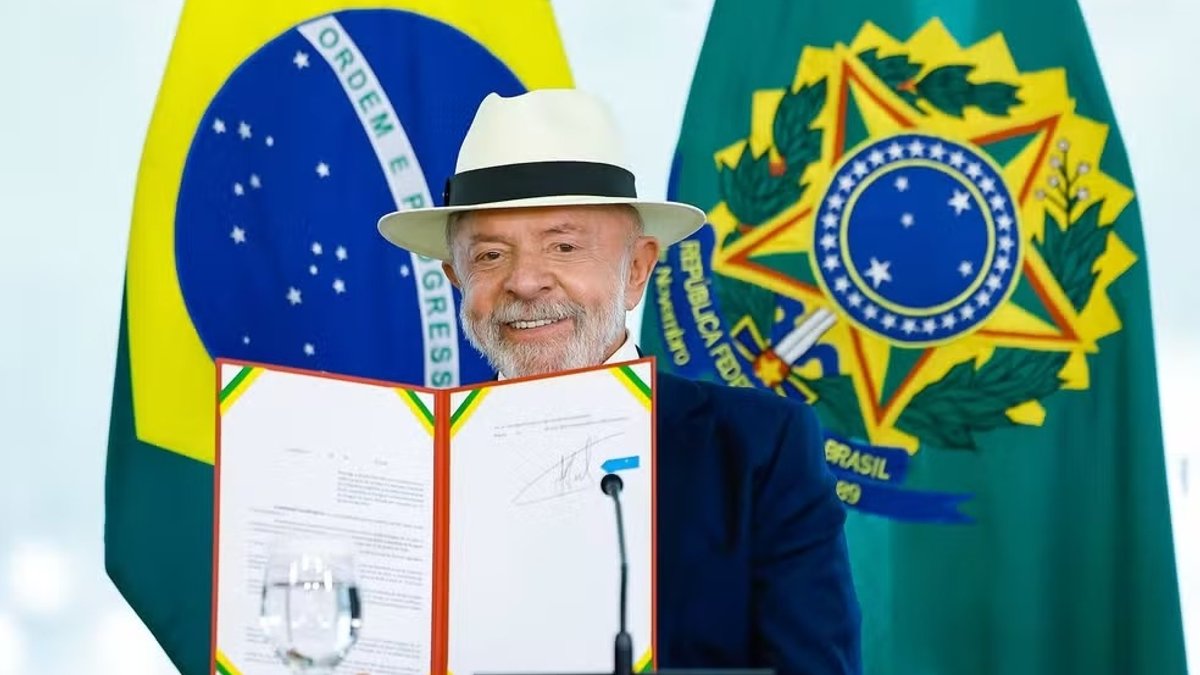
President Luiz Inácio Lula da Silva signed this Tuesday (28), at Palácio do Planalto, the decree promulgating the agreement between Mercosur and the European Union (EU). The treaty should enter into force, provisionally, from May 1st in Brazil.
Super Rectangle (728×90) – Position 17
The measure is the final act to incorporate international treaties and agreements into the Brazilian legal system, allowing the gradual application of its rules between the blocs.
The promulgation occurs after the approval of the text by the National Congress. The commitment creates a free trade zone that involves 31 countries, 27 from the EU and four from Mercosur, with a population that, combined, results in 720 million inhabitants and around US$22 trillion in Gross Domestic Product (GDP).
The Minister of Foreign Affairs, Ambassador Mauro Vieira, stated that the agreement is a historic milestone for the blocs.
“The agreement means the deepening of the relationship with our second largest trading partner and Brazil’s largest foreign investor. With it, we have the potential to increase the diversification of global partnerships, increase our exports and definitively integrate Brazil into European production chains”, he stated.
Changes:
According to the National Confederation of Industry (CNI), more than 5 thousand Brazilian products sold to the European bloc will have zero tariffs in this initial phase. Without European Union tariffs, Brazilian companies are able to sell most of their products at a lower cost, increasing competitiveness compared to competitors from other countries.
Among the sectors that are likely to feel the most positive impact are machinery and equipment (21.8% of the 2,932 products with immediate reduction); food (12.5%); metallurgy (9.1%); electrical machines, apparatus and materials (8.9%); chemical products (8.1%).
One of the highlights is the machinery and equipment sector, as almost 96% of Brazilian exports to Europe will be exported tariff-free. This includes products such as compressors, industrial pumps and mechanical parts.
In the food sector, hundreds of items will also have zero tariffs, increasing the presence of Brazilian products in European trade.
During his speech, President Lula highlighted the delay in concluding the treaty.
“When the agreement comes from colonizers to colonized people, it comes more quickly, but when colonized people decide to stand up and say that they have rights, things create more difficulties because then we become competitive with products that are produced in other countries”, he stated.
The president also declared that the agreement “was made with iron, sweat and blood”.
“There are many things they want to avoid, for Brazil to grow, compete, place its products on the foreign market. And he came at the moment to reinforce the established idea of multilateralism”, he stressed.