
DAC Level 5 by four different manufacturers passed lab-based interoperability tests
The Digital Automatic Coupler (DAC) is one step closer to fully digitising and automating (de)coupling of freight trains. Europe’s Rail published the results of a…
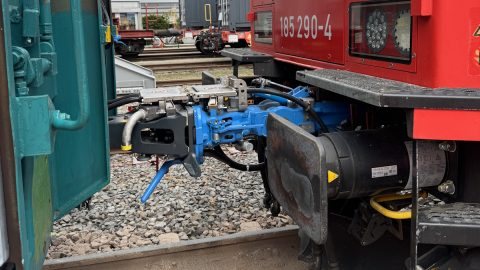
The Digital Automatic Coupler (DAC) is one step closer to fully digitising and automating (de)coupling of freight trains. Europe’s Rail published the results of a December 2025 lab-based test, showing that couplers by different manufacturers have no problem working together. The tests concerned the latest update to the DAC technology, the “Level 5” iteration. It introduces remote-controlled automatic decoupling, in addition to automatic coupling of air pipes, data cables and power cables, as well as electronically controlled pneumatic (ECP) braking.
The challenge is that four companies manufacture their own versions of DAC Level 5 couplers. In real-life operations, these need to work together seamlessly. The December 2025 laboratory tests showed that they can do so in a controlled environment. The couplers by Voith, Knorr-Bremse, Dellner and Wabtec encountered no problems during the various tests conducted.
In the laboratory, the couplers were tested while lined up straight, but also deliberately misaligned, up to 22 centimetres sideways or 12.5 centimetres up and down.
The release motors were also tested in three ways: one side releasing alone, both sides releasing while the wagons were pressed together (as when brakes are on), and both sides releasing with no pressure. Each had to finish within 3 seconds.
This story was originally published by RailFreight.com. Read the full story at RailFreight.com →


Conversation