
Global robot density reaches 152 units per 10,000 employees
Robot density in the global manufacturing sector has reached a new peak, led by South Korea, Singapore, and Germany, according to the International Federation of Robotics (IFR).South Korea remains the world’s undisputed leader in…
Robot density in the global manufacturing sector has reached a new peak, led by South Korea, Singapore, and Germany, according to the International Federation of Robotics (IFR).
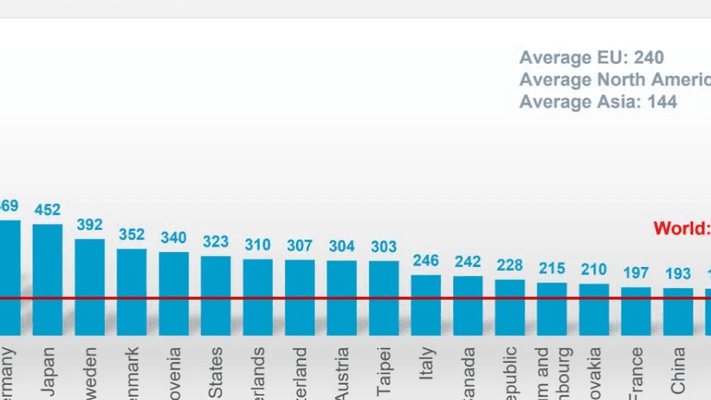
South Korea remains the world’s undisputed leader in robot density, with 1,066 industrial units per 10,000 employees. Singapore follows in second place with 873 units, while Germany secures third place, at 469 units. All three nations vastly outperformed the new global average baseline, which has risen to 152 units per 10,000 employees.
In other regions, robot density in the European Union (EU-27) increased by around 35 % within five years (2020-2025), reaching a new record of 240 units. Five of the top ten most automated economies are members of the European Union: Germany, Sweden, Denmark, Slovenia and the Netherlands. North America´s robot density rose by around 24 % over the same period (2020-2025) reaching 214 units. The United States remain 8th worldwide with 323 units per 10,000 employees. Canada follows with 242 units and Mexico with 64 units. Robot density in Asia increased by about 47 % within five years (2020-2025), reaching 144 units. Next to the region's front runners, South Korea and Singapore, Japan with 452 units ranks in 4th position among the top 10 most automated manufacturing countries. China, as the world´s largest market for industrial robots, now has a robot density of 193 units per 10,000 employees – ranking 19th globally. This result is based on employment data of the National Economic Census, conducted by China's National Bureau of Statistics. China’s robot density increased by 147 % from 2020 through 2025.
This story was originally published by DC Velocity. Read the full story at DC Velocity →

Conversation