
Gulf producers stand to gain as China replaces Iranian loss
Vortexa Freight Weekly
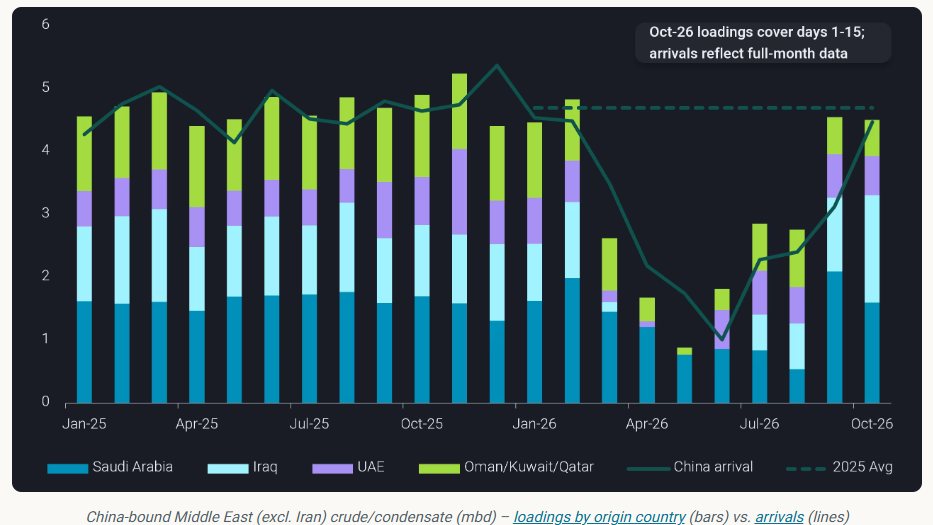
The loss of Iranian crude creates an opening for Gulf producers, while China’s fuel export policy is closely linked to Middle East Gulf crude availability.
China’s non-Iranian Middle Eastern crude arrivals are set to reach their highest level since the war began, despite VLCC tightness and Hormuz ship-to-ship (STS) bottlenecks delaying cargo deliveries. As Iranian supplies dwindle, Gulf producers — particularly Saudi Arabia and Iraq — are well positioned to capture more of China’s crude demand. Meanwhile, Beijing’s fuel export policy remains closely tied to Middle Eastern crude availability, with tighter quotas limiting the scope for China to expand seaborne product exports in Q4.
Recent Middle Eastern crude arrivals into China have come entirely from the Middle East Gulf (MEG), rather than the Red Sea or Mediterranean, as China-bound loadings have shifted fully back to the MEG since late July.
Although voyages from the MEG to China are taking longer because of STS transfers East of Hormuz or near India, non-Iranian Middle Eastern crude arrivals are still expected to reach around 4.5mbd in October, close to the 2025 average of 4.7mbd.
This story was originally published by Breakwave Advisors. Read the full story at Breakwave Advisors →
Conversation