
Interview: Olivier Besson (EVIAS) on conductive charging for ports
Cavotec and EVIAS are preparing a first pilot of an automatic conductive charging system for heavy-duty electric vehicles. WorldCargo News spoke to Olivier Besson, CEO of EVIAS, about the technology and its potential applications…
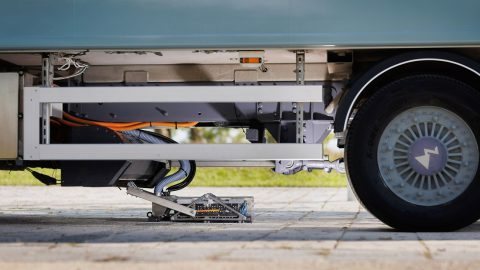
Cavotec and EVIAS are preparing a first pilot of an automatic conductive charging system for heavy-duty electric vehicles. WorldCargo News spoke to Olivier Besson, CEO of EVIAS, about the technology and its potential applications in ports.
Headquartered in Rosières-près-Troyes, with an office in Stockholm, EVIAS is developing conductive charging technology for applications including road freight, autonomous vehicles, public transport, airports and ports. Conductive charging can provide an electric vehicle with a short, high-power charge, allowing the size of the battery to be reduced by up to 60%.
Cavotec and EVIAS announced a global distribution agreement in September, under which Cavotec will distribute and install EVIAS technology for port applications.
The EVIAS system consists of an electrified charging rail that is embedded in the ground. Track sections are manufactured in 6m lengths that are 15cm wide and 15cm deep. A charging collector on the electric vehicle automatically deploys, connects and retracts with the charging track. Once connected, the rail supplies electricity to the vehicle’s powertrain while also charging its battery. The vehicle can therefore draw power directly from the track while travelling over the electrified section or while stationary. At the end of the section, the collector automatically lifts away from the rail and folds back into its stowed position. In a port application, vehicles will likely operate in a loop, using the same charging track
This story was originally published by World Cargo News. Read the full story at World Cargo News →

Conversation