
U.S. container imports reached their highest September on record
U.S. container imports reached their highest September volume on record, reaching 24.8% above the pre-Covid mark of September, 2019, according to the Global Shipping Report from supply chain software vendor Descartes.By the numbers, September…
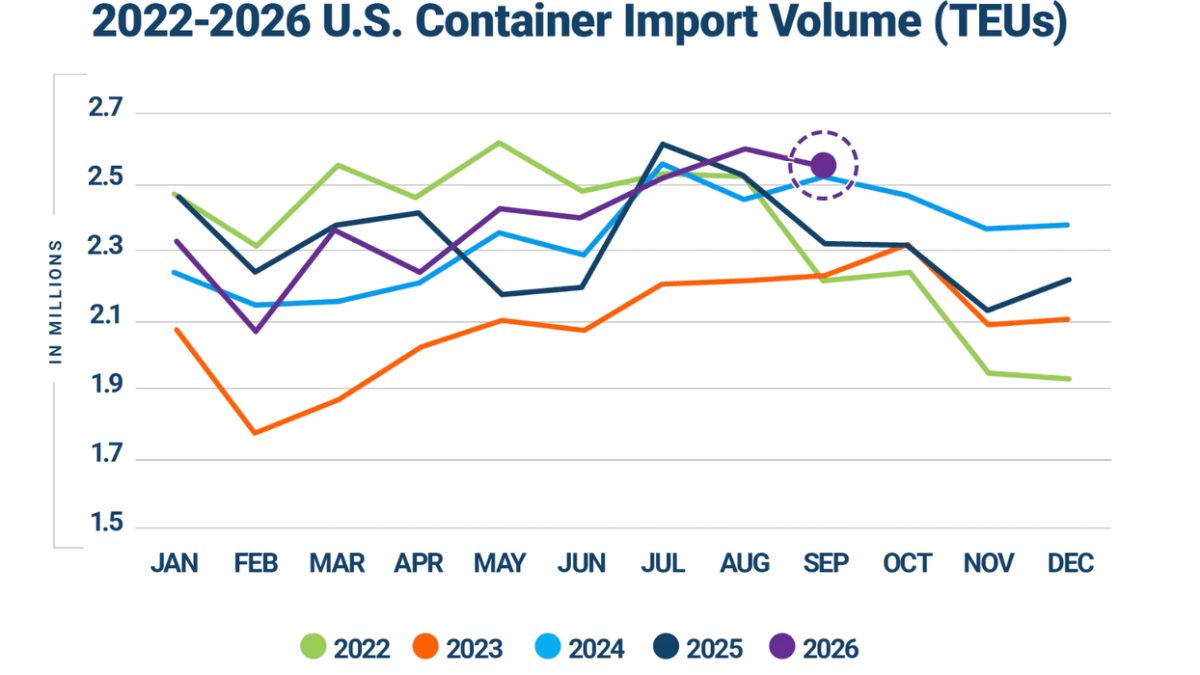
U.S. container imports reached their highest September volume on record, reaching 24.8% above the pre-Covid mark of September, 2019, according to the Global Shipping Report from supply chain software vendor Descartes.
By the numbers, September imports to the U.S. totaled 2,546,261 twenty-foot equivalent units (TEUs) in September 2026, down 2.2% from August and up 10.3% from September 2025.
The increase came despite stormy conditions in worldwide container flows. Descartes cited an array of changes to trade conditions, including: Middle East maritime incidents and new carrier fuel charges added to routing and cost risk; Section 232 tariff treatment for specified pharmaceuticals took effect for additional companies on September 29; the Panama Canal Authority announced a partial restoration of transit capacity; and some carriers are resuming selected Suez Canal services even as Red Sea security remains uncertain.
Much of the increase was driven by China-origin imports, the numbers showed. U.S. containerized imports from China reached 924,454 TEUs in September 2026, increasing 40,136 TEUs (4.5%) from August and 161,682 TEUs (21.2%) from September 2025 (see Figure 4). China represented 36.3% of total U.S. container imports, up from 34.0% in August.
This story was originally published by Supply Chain Quarterly. Read the full story at Supply Chain Quarterly →



Conversation