
UPS and Pickle Robot: Has Robotic Truck Unloading Finally Reached Its Scale-Up Moment?
Warehouse automation has transformed many areas inside the four walls. Automated storage and retrieval systems can dramatically increase storage density. Autonomous mobile robots can reduce worker travel. Robotic palletizers can automate repetitive end-of-line tasks.…
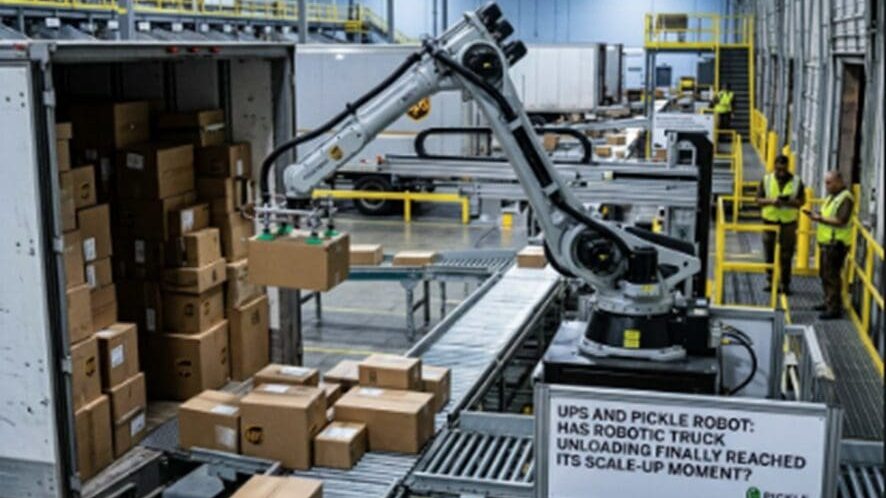
Warehouse automation has transformed many areas inside the four walls. Automated storage and retrieval systems can dramatically increase storage density. Autonomous mobile robots can reduce worker travel. Robotic palletizers can automate repetitive end-of-line tasks. Sortation systems can move thousands of parcels through distribution centers every hour. Yet one stubbornly manual process remains at many facilities: unloading the truck.
That could be starting to change. UPS reportedly plans to invest approximately $120 million to purchase 400 truck-unloading robots from Pickle Robot, with deployments expected at multiple facilities beginning in the second half of 2026 and continuing into 2027. The size of the order makes this development particularly interesting. This is no longer simply a robotics demonstration designed to determine whether a machine can unload boxes from a trailer. It raises a more important question for warehouse operators: Has robotic truck unloading reached the point where it can be deployed economically across a network?
Truck unloading looks deceptively simple. Move into a trailer, pick up a carton and place it onto a conveyor. But automation encounters considerable variability. Boxes arrive in different sizes, weights and orientations. Loads shift during transportation. Cartons become damaged. Trailers have confined working spaces. Temperatures can become uncomfortable, particularly during summer and winter.
Traditional warehouse automation performs best when processes are predictable. The dock often provides exactly the opposite environment. This explains why much warehouse automation has historically begun deeper inside the facility, where inventory can be routed into standardized totes, cartons, pallets and storage locations. Robotic unloading represents an attempt to extend automation into a much less structured environment.
This story was originally published by Logistics Viewpoints. Read the full story at Logistics Viewpoints →



Conversation