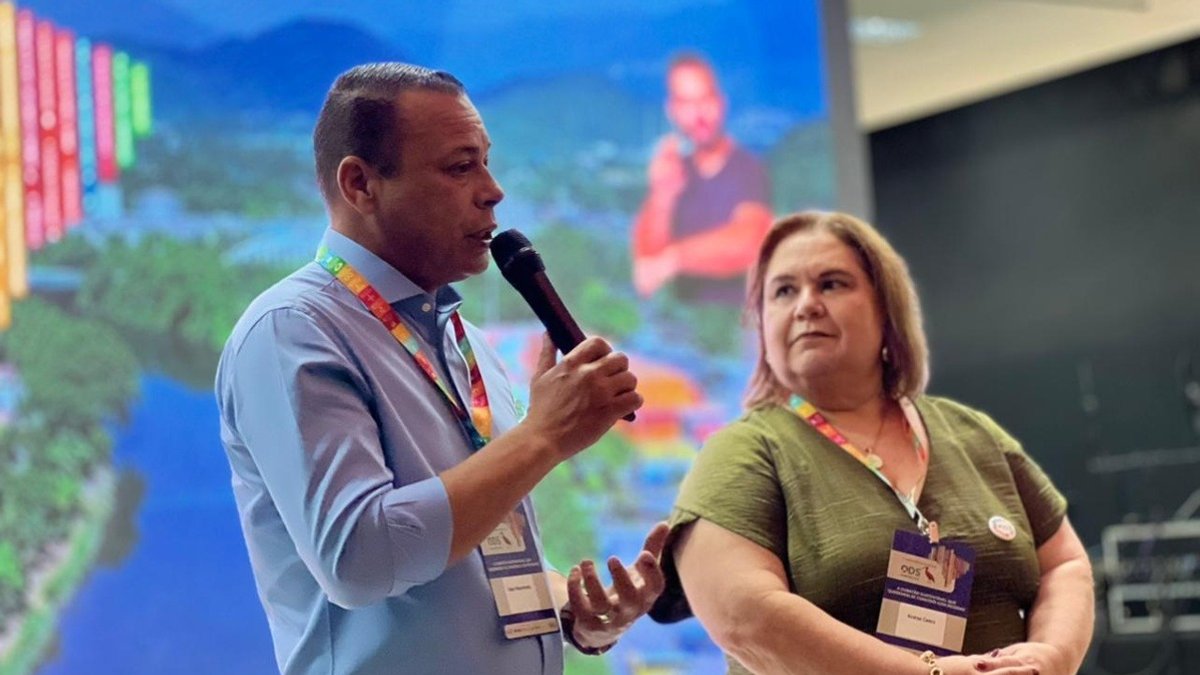
Cubatão City Hall holds 1st SDG Municipal Conference
Municipality of Cubatão | PMC Disclosure
Cubatão City Hall promoted this Tuesday (31) the 1st Municipal Conference on the Sustainable Development Goals (SDGs), held at the Dr. José Edgard da Silva Cultural Block, consolidating an important space for social mobilization, intersectoral dialogue and collective construction around the 2030 Agenda. With the motto “The Sustainable Cubatão we want is built with people”, the meeting was part of the preparatory stage for the National SDG Conference, which will take place in Brasília between June 29th and July 2nd. Established by Decree No. 12,288, of February 26 of this year, the conference’s central theme was the strengthening of democracy and human rights as the basis for a new model of sustainable development.
Super Rectangle (728×90) – Position 17
The conference was marked by broad participation from civil society, academic institutions, social movements, the productive sector and citizens, promoting qualified debates on six strategic axes: Democracy and strong institutions; Environmental sustainability; Social inclusion and combating inequalities; Technological innovation; Participatory governance; and Multisectoral collaboration and financing of the 2030 Agenda.
Mayor César Nascimento highlighted the importance of the 1st SDG Municipal Conference as a milestone for strengthening the sustainability agenda in Cubatão. He highlighted the signing of the Technical Cooperation Agreement with the Federal Government as one of the main results of the event, especially in the advancement of initiatives related to the carbon credits market.
The head of the Cuban executive branch also emphasized the municipality’s leading role in the environmental agenda, recalling Cubatão’s participation in international debates, such as COP30 and the construction of concrete solutions that are now beginning to generate practical results. According to him, the municipality is preparing to transform environmental assets, such as mangroves and vegetation areas, into opportunities for sustainable development and resource generation.
“Today we take a very important step with the conference and the signing of the technical cooperation agreement with the Federal Government, which paves the way for us to advance on strategic issues such as carbon credits”. He also reinforced the city’s role as a reference in the collective construction of public policies, highlighting the involvement of departments, institutions and the population to consolidate Cubatão as a protagonist in its own history.
Nascimento understands that Cubatão has been consolidating itself as a protagonist on the SDG agenda. “This is the result of serious work that has already led us to participate in international debates and is now beginning to generate concrete results for the city. With carbon credits, we will be able to transform our preserved areas, such as mangroves and forests, into opportunities for sustainable development, attracting investments and generating benefits for the city. Cubatão has always been a resilient city, and now we are building, together with society, a new chapter, being protagonists of our own history.”
After voting on the proposals, the election of delegates who will represent Cubatão at the national stage was held, in Brasília, during the National SDG Conference, which will take place between June 29th and July 2nd, reinforcing the municipality’s presence in the national debate.
Representative of the Federal Government – The conference also included the participation of the executive secretary of the Presidency of the Republic, Lavito Baccar1ssa, who highlighted the innovative nature of the process carried out in Cubatão and its relevance for the country. Baccarissa said that the conference process that Cubatão held today is a milestone for Brazil and the sustainable development agenda.
We need to translate the 2030 Agenda into people’s reality, as an agenda to combat inequality, hunger and exclusion, territorializing actions and building, from the municipalities, a concrete transformation plan until 2030. The representative of the Federal Government also highlighted the importance of integrating public power, the productive sector and academia, in addition to strengthening the role of municipalities in implementing public policies aligned with the Sustainable Development Goals.
Management’s commitment to the 2030 Agenda, academic contributions and regional challenges were highlighted at the event. During the opening, Dr. Andrea Castro – Secretary of Housing, SDG Coordinator and President of the Municipal Council, highlighted the historical importance of the initiative.
“Today is a very special and exciting day for all of us, with the holding of our first Municipal Conference on Sustainable Development Goals, a milestone for Cubatão.” She emphasized that the UN 2030 Agenda became part of our planning from the Government program, structured based on the SDG axes, which demonstrates management’s commitment to sustainable public policies. “We brought the SDGs to the center of the administration, integrating the cabinet and all departments, with the fundamental support of Mayor César Nascimento”.
Another highlight of the event was the participation of the rector of the Catholic University of Santos, Prof. Dr. Cléber Ferrão Corrêa, who brought important reflections on the region’s social challenges, especially in the areas of housing and sustainable urban development.
The rector highlighted the significant housing deficit in Baixada Santista and the impacts of disorderly urban growth, in addition to reinforcing the importance of integration between academic knowledge and the formulation of public policies. He also valued innovative initiatives developed in the municipality, such as housing projects adapted to the local reality, and research aimed at the Sustainable Development Goals.
“We are facing a significant housing deficit in our region and we need to reflect on the advancement of vertical integration. Where are these people going? This is an urgent challenge that requires concrete and integrated solutions. 25 years ago, at the beginning of my academic career, I experienced extremely difficult situations in vulnerable communities. Today, looking back, the question that remains is: what, in fact, changed during this period?
The floating houses project is a highly relevant initiative, which we have already used as an international case in environmental law. It shows that it is possible to innovate and propose sustainable alternatives to historical problems”, added the rector.
Qualified debates and representation – The special coordinator of the SDGs, Sandra Regina Fonseca de Godoi, highlighted the quality of the debates and the social mobilization. “Today was a memorable day for our municipality. We held a conference with significant and diverse participation, bringing together civil society, academia and social movements around a common objective: building sustainable solutions for our territory. The debates were extremely qualified, especially in the afternoon, when we delved into six fundamental strategic axes for the formulation of permanent public policies. We left this meeting stronger and with guaranteed representation for the national stage.”
Cooperation agreement and climate agenda – One of the main milestones of the event was the signing of the Technical Cooperation Agreement (ACT), aimed at structuring initiatives related to the carbon credits market. The municipal secretary for the Environment, Climate Security and Animal Welfare, Cleiton Jordão Santos, highlighted the impact of the initiative: “This technical cooperation agreement represents a fundamental step for Cubatão to advance in the structuring of projects linked to the carbon credits market. We are inserting the municipality in a strategic context, connected to national and international discussions on climate change and sustainability. It is an opportunity to develop concrete projects, attract investments and strengthen Cubatão’s environmental agenda.” The secretary highlighted the importance of participatory governance. “The creation and action of the Council are essential, as they guarantee the participation of civil society alongside public authorities in the construction of permanent public policies.”
Municipal Council and governance and Adherence to the ODS Cubatão Movement – During the conference, the Municipal Council for Sustainable Development Goals took office, which now has 84 members, 44 members and 40 substitutes, in addition to three vacancies. The collegiate brings together representatives of public authorities, teaching and research institutions, professional councils, the productive sector and organized civil society, strengthening the governance of the 2030 Agenda in the municipality. The event also marked the expansion of the Cubatão SDG Movement, with the participation of several institutions, companies and civil society organizations, including:
Mentoring Soullutions Soluções Humanizados Ltda; Children of Ganga Zumba Cultural Association; ABC Marbas; Collective 302; RCF Sports/Marina Andrade; Guatá Institute; Association of Residents of Pinheiro do Miranda and Fabril; Soroptimist Of Cubatão; Link Technology; TO Morro do Índio; Zanzalá Artistic Association – Arzanza; CTM Usinagem Ltda; Association of Environmental Monitors of Pinheiro do Miranda; MFG; Creative Hands Association of Cubatão (Amacri); Municipal Council on the Status of Women; Municipal Education Council; Casa Menino Felipe Association (ACAMEFE); CACS FUNDEB; UME State of Minas Gerais; and UME Our Lady of Fátima.
Results and next steps – As a result of the debates, priority proposals were approved, one in each thematic axis — which will be forwarded to the national stage and will also serve as a basis for improving public policies in the municipality. The program also included reading and approval of the internal regulations, simultaneous debates, voting on proposals and moments of integration between participants. The conference guaranteed broad participation and diversity, consolidating itself as an essential democratic space for the advancement of a fairer, more inclusive and sustainable development model in Cubatão.
Cubatão City Hall is aligned with the 17 UN Sustainable Development Goals (SDGs). This initiative is part of the proposed path to implementing the 2030 Agenda: SDG 1 – eradication of poverty; SDG 2 – zero hunger and sustainable agriculture; SDG 3 – health and well-being; SDG 4 – quality education; SDG 5 – gender equality; SDG 6 – drinking water and sanitation; SDG 7 – clean and affordable energy; SDG 8 – decent work and economic growth; SDG 9 – industry, innovation and infrastructure; SDG 10 – reducing inequalities; SDG 11 – sustainable cities and communities; SDG 12 – responsible consumption and production; SDG 13 – action against global climate change; SDG 14 – life in water; SDG 15 – life on land; SDG 16 – peace, justice and effective institutions; SDG 17 – partnerships and means of implementation; SDG 18 – ethnic-racial equality; SDG 19 – art, culture and communication.
Rectangular Intermediate Banner (320×50) – Position 50