
Nepal’s iron and steel exports to India have dropped sharply after New Delhi imposed a three‑year safeguard duty on selected steel products, triggering worries over export earnings, government revenue and jobs in one of Nepal’s key industrial sectors. Industry insiders warn that the downturn could deepen as India considers further restrictions on imports, especially on steel made with Chinese raw materials.
In the first 11 months of the last fiscal year, Nepal earned Rs15.42 billion from iron and steel exports to India, but in the same period of the current fiscal year, export receipts fell by 68.67 percent to Rs4.83 billion. This translates into a loss of Rs10.59 billion in export earnings in under a year, underscoring the impact of India’s recent trade policy on Nepal’s steel industry and wider economy.
India, the world’s second-largest crude steel producer, introduced the safeguard duty in December last year to curb cheap steel imports. The duty, applied to selected steel items from China, Vietnam and Nepal, is set at 12 percent in the first year, 11.5 percent in the second year and 11 percent in the third year, while specialty steel, including stainless steel, has been exempted. Before the safeguard measure took effect, India had already imposed a temporary 12 percent tariff for 200 days in April.
Nepali manufacturers say the safeguard duty is unjustified for Nepal because it remains a least developed country with high economic and environmental vulnerabilities, and they argue the measure has severely disrupted production and exports. Nepal’s steel export basket has traditionally been dominated by zinc sheets, with India serving as the primary market. According to a UNDP assessment of Nepal’s brick, cement and steel sectors, annual domestic demand for iron and steel is about 1.2 million tonnes and local producers can meet that requirement.
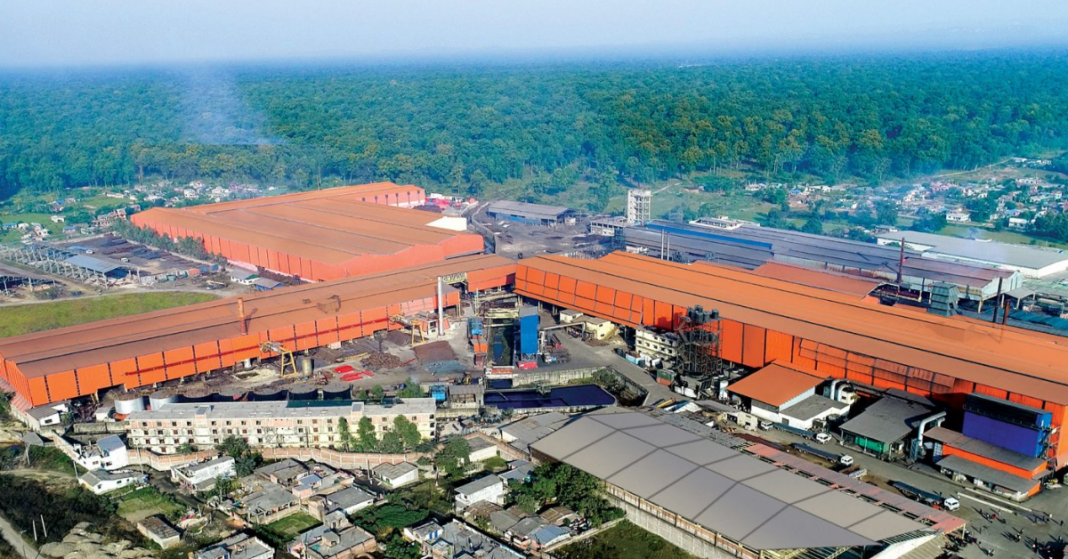
Industry experts estimate that demand for iron and steel is growing by around 20 percent a year, driven by construction and infrastructure activities. Annual demand for rebars alone is about 500,000 tonnes, and domestic manufacturers supply nearly 80 percent of this volume. Nepal currently has around 83 registered iron and steel factories, including 54 plants producing thermo-mechanically treated (TMT) bars.
Department of Customs data show that Nepal exports roughly 145,932 tonnes of iron and steel products worth Rs16.35 billion to India in a typical year. Export items are largely flat-rolled iron and non-alloy steel products wider than 600 mm and between 1 mm and 3 mm thick, including cold-reduced steel coils used in automobile panels, electrical appliances, furniture and general fabrication. Nepal also ships rolled iron and steel coated with aluminium-zinc alloys, plastic-coated sheets, and stainless steel tableware, kitchenware and household goods to the Indian market.
Reuters has reported that India plans to review steel imports in August before deciding whether new steps are needed to control inbound shipments, particularly those originating from China. No decision has yet been taken on imposing anti-dumping duties or introducing other trade remedies, but the possibility of tighter import rules has already alarmed Nepali steel producers.
Company officials say that the safeguard duty is not the only barrier hurting exports, pointing to challenges in obtaining and renewing Bureau of Indian Standards (BIS) certification. Sunil Manot, chief finance officer at Hulas Steel Industries, one of Nepal’s major steel firms, says India has put their BIS renewal application on hold, effectively blocking market access for certain products. Hulas Steel exports Galvalume (GL) and pre-painted Galvalume (PPGL) steel sheets to India and produces around 10,000 tonnes of GL and PPGL each month, with capacity to export around 20 percent of output.
Galvalume is a steel sheet coated with an aluminium-zinc-silicon alloy, widely used in roofing and cladding. Manot believes India’s upcoming annual review of the safeguard duty on iron and steel products, expected around October or November, offers an opportunity for Kathmandu to push for removal of the duty on Nepali products through high-level trade talks. He says manufacturers are preparing to formally advise Nepal’s Ministry of Industry on possible ways to address the problem.
Other producers report similar issues linked to India’s Steel Import Monitoring System (SIMS). Devendra Sahu, general manager of Panchakanya Group, which manufactures stainless steel water tanks among other items, says the company halted exports for nine months because it could not secure BIS certification for either raw materials or finished products under SIMS. He notes India does not have a BIS standard specific to stainless steel water tanks, complicating compliance for Nepali exporters.
According to Sahu, Panchakanya sources steel from Taiwan for its tanks and has only recently resumed exports, about three months ago, after India introduced a simplified ‘Saral SIMS’ system. The new arrangement allows Indian importers to bring in consignments of stainless steel water tanks weighing 20 to 25 tonnes, which suits Panchakanya’s products that are each under one tonne. Apart from India’s 6 percent Goods and Services Tax (GST), the company says its exported water tanks are not facing additional duties.
Panchakanya Group manufactures around 25,000 stainless steel water tanks annually, with 10 to 12 percent of production going to India. The firm operates plants in Bhairahawa in Rupandehi district and in Thankot, Kathmandu, and much of the output from Bhairahawa is geared toward the Indian market.
Trade experts argue that Nepal’s Ministry of Industry and other relevant agencies have not responded adequately to emerging trade barriers affecting domestic manufacturers and exporters. Former commerce secretary and trade expert Rabi Shankar Sainju says that trade-related disputes are inevitable but must be handled through timely government-to-government dialogue with India. He points out that Nepal has often failed to raise key issues, such as tea export challenges and BIS certification obstacles, during high-level visits, allowing problems to persist and recur.
Industry stakeholders say sustained diplomatic engagement with New Delhi is essential if Nepal is to secure relief from safeguard duties and non-tariff barriers and protect its iron and steel export sector. They warn that without proactive negotiations, Nepal risks losing more revenue, investment and employment in steel manufacturing while India continues to tighten its import regime.