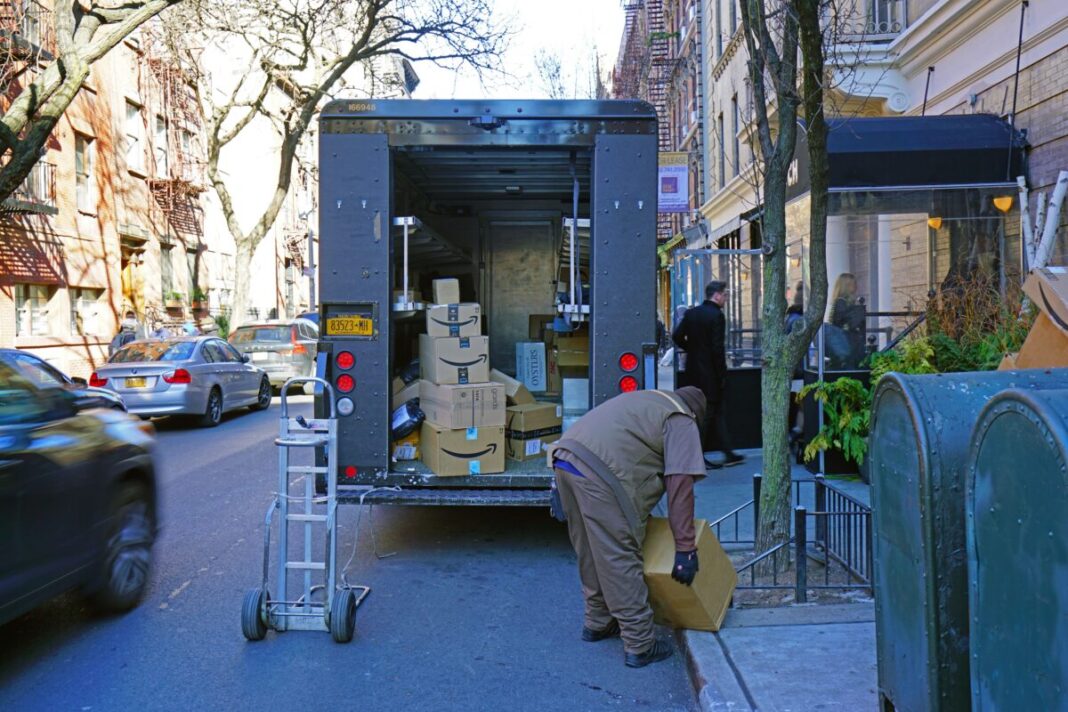

Official proceedings on New York City’s potentially groundbreaking law that would impact the relationship between Amazon and its Direct Service Providers (DSPs) has gone quiet for the summer but amidst signs that there might be a shift in the most draconian aspects of the law following a public hearing in April.
The dedicated page for the legislationknown as the Delivery Protection Act but also referred to as Intro 518 based on its labeling within the New York City City Council, shows no action on the bill since the April hearing.
While the day’s presentations and pre-hearing demonstrations could be passionate and loud–especially outside City Hall before it opened its doors for the Council session–some of the testimony by a panel of business group representatives was somewhat less pointed as members of the Council’s Committee on Consumer and Worker Protection considered the possible ramifications of the legislation’s implementation.
While there are numerous provisions in the proposal, its key regulations would be that delivery companies in New York City would need to be licensed, and that subcontracting out deliveries by a company operating the “core services” of delivery would be prohibited. “All workers providing core warehouse services at last-mile facilities in the city shall be directly employed by the facility operator,” is the wording in the legislation.
Requirement to hire
Another key aspect of the law is that workers displaced by the transfer of those “core services” from an independent contractor–like an Amazon DSP–to the “facility operator,” such as Amazon, must be hired by the facility operator.
Licenses can be revoked if a New York City agency finds various violations of labor standards.
“Things tend to get quiet in the summer, particularly as the Council and the mayor work through the budget,” Kendra Hems, president of the Trucking Association of New York, said in an interview with FreightWaves. “At this point, we’re anticipating we will not see too much more until maybe sometime in the fall.”
There are 32 co-sponsors of the bill in the 52-member Council. That is down from the 41 co-sponsors of its predecessor bill, which died at the end of 2025 when the Council failed to take action on it by the end of the year.
But even as the Delivery Protection Act sits on the Council calendar with no further action listed, sources close to the process said the apparently dead summer masks the fact that this is a period known as “amendment season,” when changes to the original bill are being discussed and drafted, though none have shown up in the bill as of yet.
The backers of the bill originally sponsored by Council member Tiffany Caban are reportedly suggesting they would be open to some changes in the legislation, including a possible option where Amazon and its DSPs become joint employers of the drivers and other employees. But Amazon has fought hard against other efforts to be labeled a joint employer, and recently looked headed to a significant victory in that battle with the Teamsters in California.
Hems called the provisions in the proposal “gross overreach.” An email sent to an Amazon spokesman had not been responded to by publication time.
A change in structure?
Another option that might satisfy the Council’s backers might be for the DSPs to be allowed to become more of an independent contractor (IC), with less control–a loaded word in the legal landscape for defining a true IC–than Amazon (NASDAQ: AMZN) now exerts. Sources close to the DSP ecosystem have suggested that Amazon has considered changing that tight model, as it is frequently battling over the question of control in courts and other forums.
James Parrott, a labor economist at the Center for New York City Affairs at The New School, who has specialized in issues relating to gig workers and independent contractor status, was skeptical that there could be a significant level of change that would still meet the goals of the backers.
Parrott, who is not connected to any of the parties in the current battle, said the goal of the backers should be to emulate “other firms in the delivery business, which brings to mind UPS and the U.S. Postal Service.”
“These are both companies heavily involved in delivery who do employ their drivers and delivery workers as employees,” Parrott said in an interview with FreightWaves. “On top of that, they’re unionized, so they get pretty good benefits in addition to decent pay, and so on. So that’s the model I think that the Council sponsors are looking to, that Amazon and FedEx should level up to and not have everybody else level down to the rock bottom level where, where Amazon and FedEx operate.”
Federal Express’ (NYSE: FDX) independent delivery companies are generally considered to have more flexibility in their operations than Amazon DSPs, and that could be a pathway for Amazon to follow. (FedEx would fall under the provisions of the Delivery Protection Act, but statements by the bill’s supporters have made it clear that Amazon is their target.)
Whether bilateral discussions along those lines can ever occur remains to be seen. As one source close to the backers of the legislation said, “Amazon and their wide array of lobbyists know that we would love to have a conversation with them to hear about what version of this legislation would work for them, and they refused to even engage on that,” he said.
A coalition opposing the legislation, the Five Borough Jobs Campaign, released a study late last month authored by the consulting firm of AKRF which lays out the case against the Delivery Protection Act.
While many of the arguments against the bill were in a draft of the study released in April around the same time as the Council hearing, the latest full report is almost 150 pages in length.
But the key arguments remain.
- DSPs could relocate across city lines to escape the law’s reach and remain independent, be it into Nassau County, Westchester County or New Jersey, which would result in slower service and more emissions (as well as killing localized means of delivery in dense urban areas, such as e-bikes)
- Some of those businesses might not be able to relocate and would be faced with a shutdown. That argument appeared to resonate with some Council members at the April hearing, as the DSPs are often owned by individuals and are viewed as small businesses.
- Proceeding with the legislation would bring it into a morass of legal uncertainty. Can the city require a private company like Amazon to essentially buy the DSPs? Is there a conflict with federal legislation such as the Federal Aviation Administration Authorization Act? Would the requirement to hire workers displaced by the closing of a DSP succeed in a court test?
“Carriers that rely on contracted fleets are unlikely to fully convert drivers to direct employment; instead, they would likely consolidate, relocate, and scale back in-City operations,” the report said. “This would result in job losses for drivers, couriers, warehouse staff, and dispatch personnel currently employed by contracted firms. While large direct-employment carriers may expand some operations, they are unlikely to absorb the full volume of displaced work. Across reasonable scenarios, the net effect is a smaller city workforce and reduced local delivery capacity.”
A firing fires up one side
Although there may not have been formal action on the proposed law since April, it hasn’t completely slid into the background. In June, a New York City DSP driver, Esly Paredes, made a Tik Tok video backing the Delivery Protection Act. She was promptly fired.
In a news story on the incident from The City Reporter, Vincent Satriano, which owns Satriano Logistics/STAA, where Paredes worked, was quoted as saying “This decision followed repeated violations of my company’s policies. No other factors were involved.”
A source close to the Council said the action “outraged” members of the Council, “and that strengthened their commitment to passing this bill.”
More articles by John Kingston
TQL case on broker transparency heads to oral arguments
Highway, post-Montgomery, requiring ELD hookups for all carriers
Two companies, on same day, ask for relief from HOS rules