Applied Materials in Singapore and Japan’s new subsea cable approach
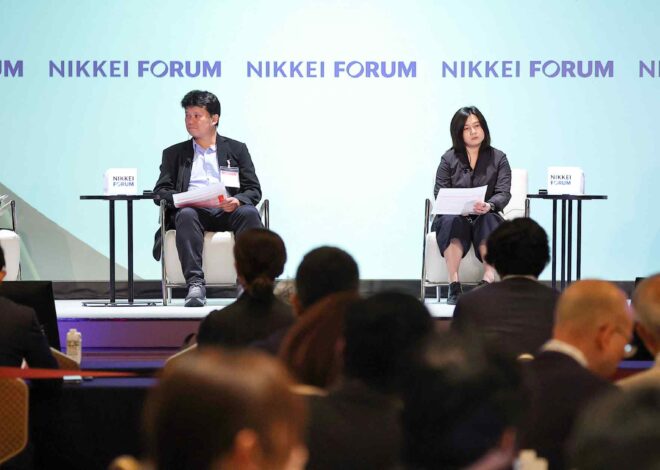
Hi everyone! This is Lauly, still trying to recover days after the conclusion of Computex, the largest and most important tech expo in Asia. If any of you visited this year’s trade show in Taipei, you will understand what I mean when I say I am exhausted.
Rapidly growing demand for artificial intelligence has driven the popularity of Computex in the past four years, as Taiwan’s tech supply chain is the epicenter of AI hardware. This year was the most challenging one so far for me and my colleague Annie Cheng Ting-Fang to cover, largely because of the earlier-than-expected arrival of Nvidia CEO Jensen Huang, which made the one-week Computex feel like it lasted two weeks.
But this year’s event was also one of the most satisfying, as we had the chance to get hands-on with some of the latest innovations powering the AI revolution. I was really excited, for example, to see the co-package optic (CPO) switch tray showcased by Nvidia at GTC Taipei, which cuts the use of copper and pluggable transceivers, and reflects a dynamic shift from electrical connection to optical connection. We were also able to see and touch the upcoming Nvidia Vera CPUs, the company’s challenger to Intel and AMD in the server CPU market.
You can take a look at these innovations yourself in these two short videos — here and here.
The Computex event itself, along with Nvidia’s GTC Taipei, was a marathon of reporting. We covered Huang’s announcement that his company is spending $150 billion a year on Taiwan’s supply chain, his keynote at GTC Taipei and his news conference about Nvidia’s ambitions in the CPU market. On top of that, we stood for hours outside of two restaurants in downtown Taipei, squeezing shoulder-to-shoulder with other global and local reporters to doorstep Huang during Nvidia’s “partner nights” with its Taiwanese and South Korean suppliers.
And that was just covering Nvidia. We also wrote about Intel’s latest move, SK Group Chairman Chey Tae-won’s first public appearance in Taiwan in years, and countless CEO keynote speeches and media briefings by major tech companies. I ran back and forth between the venue’s two halls five times on the first day of Computex alone.
Through it all, we could feel the omnipresence of Huang. On one day, he joined Marvell CEO Matt Murphy on stage during the latter’s keynote address, calling the American chip developer the “next trillion dollar company.” I was still jotting down notes on his comments when — less than 30 minutes later — Annie messaged me from the other side of the city to say that Huang had just joined Arm CEO Rene Haas on stage for his speech, too. I think that was the manifestation of “everything, everywhere, all at once.”
When Huang did his exit interview at the Songshan Airport on Friday, he told the reporters, “I’d like to come back as soon as possible. When do you want me to come back? I think Taiwan needs to rest, all of you need to rest, you need to get some sleep, right? I think the restaurants also need to rest.”
I couldn’t agree with him more.
Tools for growth
Leading American chipmaking equipment maker Applied Materials is betting big on Southeast Asia by opening a $500 million manufacturing campus in Singapore, the heart of its strategy to nearly double its global production capacity to meet the robust demand from the AI-driven chip boom, Nikkei Asia’s Cheng Ting-Fang reports from the city-state.
Applied Materials President and CEO Gary Dickerson said its chip business will grow more than 30% this year and by a similar amount in the coming years, thanks to the strong demand for AI computing power.
To capture this growth opportunity, Applied Materials’ new campus in Singapore will expand from one to three facilities, doubling its capacity there and making the Southeast Asian hub home to nearly 50% of its total capacity. The American chipmaking tool supplier also aims to increase its workforce in Southeast Asia by 1,000 people, mainly in Singapore, to support the expansion, Nikkei Asia reported earlier.
India on the sidelines
India’s once-booming stock market has lost ground to Asian rivals this year as AI-hungry investors are put off by the country’s lack of businesses able to capitalize on the sector’s boom, writes the Financial Times’ Krishna Kaushik.
Foreign investors have pulled a net $30 billion from Indian stocks this year, including a record $2.3 billion on June 1, according to securities depository NSDL, pushing the market down to seventh place globally by market value from fifth place just a week ago.
“Global investors are thematic investors,” said Arvind Chari, chief investment strategist at Quantum Advisors India. “If you’re trying to play AI as a theme, there is literally nothing to play in India.”
India’s stock market capitalization was recently overtaken first by Taiwan and then by South Korea, as the value of Indian equities held by foreign investors slumped to a 10-year low of 6.9 trillion rupees ($72 billion) on June 9.
The value of Indian stocks was more than double that of Taiwanese stocks and roughly 3.5 times that of South Korean stocks 18 months ago, according to analysts at Bernstein. “Fast forward just five months into 2026, and that lead has evaporated,” they added.
Foreign investors have reduced their exposure to India’s vast information technology services sector by more than a third since the start of the year, in a sign of nervousness over how AI could disrupt an industry that is the largest white-collar employer in the country.
Under the waves
Japanese companies are aiming for a bigger role in Asia’s subsea cable market, as booming artificial intelligence demand transforms the construction and ownership models of these vital pieces of communication infrastructure, writes Nikkei Asia’s Tsubasa Suruga.
Doubling construction costs, prolonged project timelines due to regulatory and geopolitical factors, as well as complex consortiums, are pressuring the entire undersea cable industry to move faster.
To help it do that, Japan’s NTT Data Group, one of the world’s leading undersea cable builders, has formed a dedicated venture with a small group of Japanese partners, rather than a large consortium as in the past, to build the Intra-Asia Marine (I-AM) Cable that links Japan and South Korea with Malaysia and Singapore, with branches to Taiwan and the Philippines.
NTT’s project is a reflection of a broader strategic shift in the subsea cable industry and Japan is emerging as an important hub for the digital infrastructure underpinning the AI era.
Expanded ambitions
Barely a week after he said chipmaker SK Hynix would double its production capacity, group Chairman Chey Tae-won raised the stakes again: The key maker of high-bandwidth memory chips for Nvidia told Nikkei Asia’s Kim Jaewon that the company aims to triple its capacity by 2034.
SK Hynix has ridden the AI wave to record profits and a trillion-dollar valuation, and Chey says demand for AI infrastructure and related investment will remain strong for years to come. He also acknowledges, however, that more stock market volatility is likely. SK Hynix’s shares have surged, thanks to its key role in the AI supply chain, though like those of rival Samsung, they were hit by a wave of selling in recent days.
The chairman also talked about SK Hynix’s longer-term expansion beyond abroad and how Japan could fit into those ambitions. He also called for an “economic community” between South Korea and Japan to help the two neighbors navigate an increasingly uncertain world.
Suggested reads
1. Tencent raises $4.6bn in dual dollar, yuan bond issuances (Nikkei Asia)
2. ASML chief warns EU against directing chip supplies (FT)
3. Chinese entrepreneur’s e-truck startup Windrose faces unpaid wage claims (Nikkei Asia)
4. Nvidia takes AI battle from the data centre to the laptop (FT)
5. Nvidia’s Jensen Huang charms South Korea, clinching AI factory deal with SK (Nikkei Asia)
6. Chinese exports climb as AI boom fuels trade (FT)
7. Tin demand for AI servers to triple by 2030, analyst says (Nikkei Asia)
8. Chips, ships and guns: South Korea booms on AI race and global conflict (FT)
9. Uncertainty plagues Taiwan’s drone industry after budget cuts (Nikkei Asia)
10. Pentagon restores Alibaba, Baidu and BYD to Chinese military groups blacklist (FT)
Podcast: Tech Latest
China’s chip tool supply chain, retooled
Welcome to the Tech Latest podcast. Hosted by our tech coverage veterans, Katey Creel and Shotaro Tani, every Tuesday we deliver the hottest trends and news from the sector.
In this episode, we are doing something a bit different: taking a look back at one of our recent chats with chief tech correspondent Cheng Ting-Fang, or Annie to her friends.
Our updated episode dives into China’s chip supply chain and how its sourcing is changing in the face of U.S. pressure.
Find us on Apple Podcasts | Spotify | YouTube | YouTube Music | Amazon Music | Voicy
For more great stories like this delivered to your inbox every week, sign up to our #techAsia newsletter. Current subscribers, click here to update your newsletters preferences.