
Gulf ports ride the investment wave
US Gulf project cargo ports report rising business. Power generation and data centre cargoes are supplementing project cargo business that comes from the mix of infrastructure, refinery and petrochemical projects, LNG and mining. Unsurprisingly,…
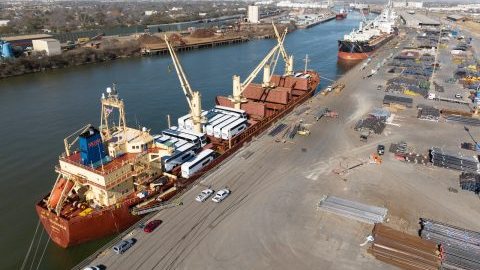
US Gulf project cargo ports report rising business. Power generation and data centre cargoes are supplementing project cargo business that comes from the mix of infrastructure, refinery and petrochemical projects, LNG and mining. Unsurprisingly, the major US ports along the Gulf of Mexico are busy, from New Orleans through Beaumont and all-around Houston. Port of New Orleans (Port NOLA) is a landlord port, with cargo handling performed by experienced private terminal operators Ports America, New Orleans Terminal and QSL.
“Our project cargo strength is the combination of heavy lift infrastructure, storage capacity and multimodal connectivity,” said Amanda Coates, vice president of cargo development. “Across six dedicated breakbulk terminals, we offer more than 13,500 ft (4,115 m) of berthing and 1.6 million sq ft (148,000 sq m) of transit-shed space.” This is in addition to staging and laydown areas.
For specialised equipment arriving on container vessels, the port offers weekly dedicated services at its Napoleon Avenue container complex with eight gantry cranes and three large-vessel berths.
Port NOLA offers the ability to transfer cargo directly between vessel, barge, rail and truck. The port-owned and operated New Orleans Public Belt (NOPB) provides on-dock rail connectivity and access to all six Class I railroads, while the dedicated truck corridor supports efficient highway access. “That allows us to handle over-dimensional cargo, industrial modules, transformers, energy equipment, steel and other high-value components moving into the heartland of the country. Our terminals also have direct connectivity to the regional interstate network, including Interstate 10,” said Coates.
This story was originally published by Project Cargo Journal. Read the full story at Project Cargo Journal →



Conversation