
Who Will Control the Supply Chain’s AI Decision Layer?
The contest among foundation-model providers and enterprise software suppliers is shifting from model performance to the authority to coordinate operational decisions. The next consequential decision in supply chain technology may not be which transportation…
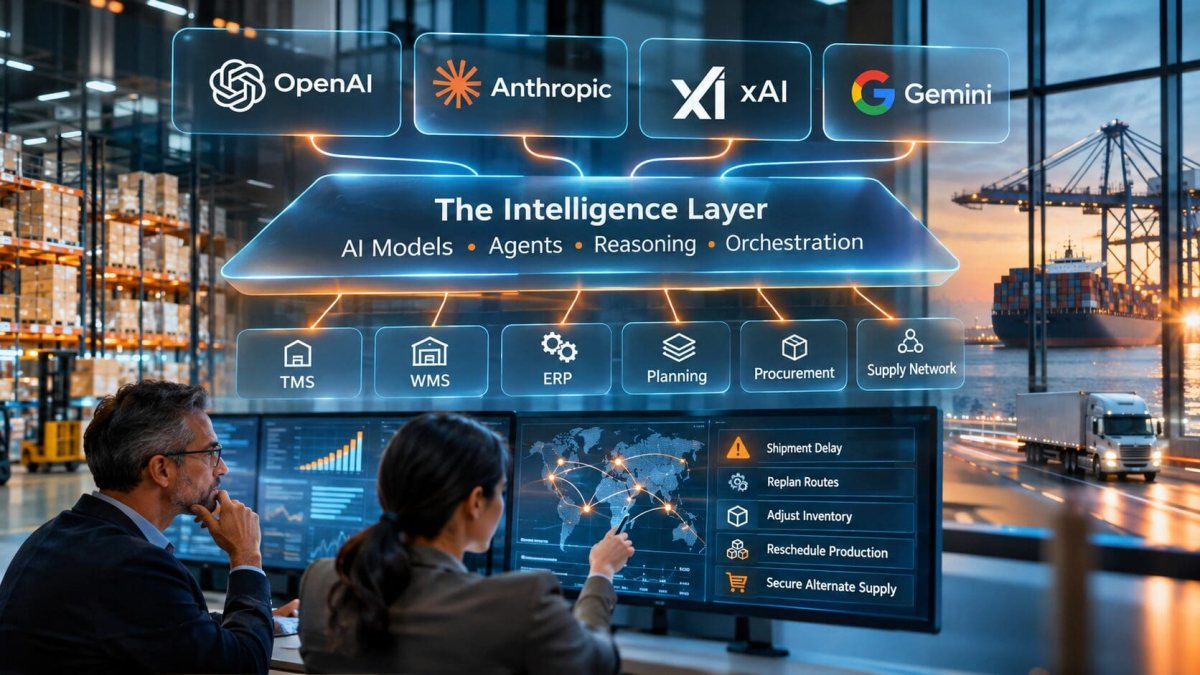
The contest among foundation-model providers and enterprise software suppliers is shifting from model performance to the authority to coordinate operational decisions.
The next consequential decision in supply chain technology may not be which transportation management system, warehouse platform, or planning application an enterprise buys. It may be who controls the intelligence layer that interprets the information in those systems, identifies the problems that matter, and coordinates a response. OpenAI, Anthropic, Google, xAI, and other model developers are pursuing that opportunity. Established enterprise software suppliers have no intention of surrendering it.
The distinction matters because a capable language model does not automatically produce a sound supply chain decision. Resolving a freight exception or supplier failure requires reliable records, specialized calculations, contractual constraints, and authority to execute transactions. The strategic question is whether the next generation of intelligence will be directed by foundation-model companies, incumbent software vendors, or an enterprise architecture that combines the strengths of both while retaining control of the operating model.
Recent releases—including OpenAI’s GPT-6.2 Astra and Sol, Anthropic’s Claude Fable 5.2, Google’s Gemini 4 Carbon, and xAI’s Grok 4.7—illustrate the pace of development. The models vary in reasoning capability, speed, cost, multimodal processing, and tool use. Those differences can be commercially important, but a public benchmark tells an executive surprisingly little about whether a system can resolve a delayed shipment or safely authorize a supplier change. Performance has to be evaluated against operational work, not model demonstrations.
This story was originally published by Logistics Viewpoints. Read the full story at Logistics Viewpoints →

Conversation