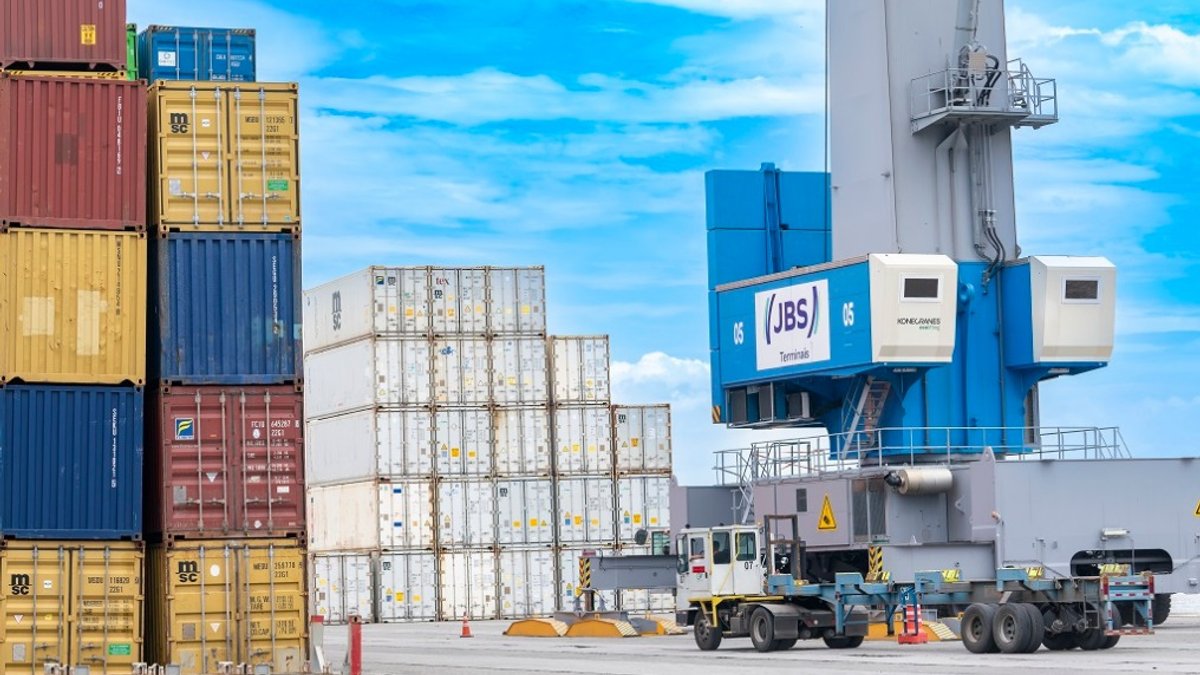
JBS Terminais expands operations in Itajaí with two new international routes
Disclosure
JBS Terminais announced the expansion of its operations at the Port of Itajaí, in Santa Catarina, with the entry into service of two new regular long-haul lines starting in June. The initiative strengthens the position of the Santa Catarina terminal as an important logistics hub for Brazilian exports, especially in the refrigerated cargo segment.
The new routes will be UCLA/Gulf to Saec String 1 ea Bossa Nova/Sirius 1. The first will connect Itajaí to the east coast of the United States, including strategic stops in the Caribbean and northern South America. The second will establish connections with Europe and Africa, through the ports of Algeciras, in Spain, and Tangier, in Morocco.
Super Rectangle (728×90) – Position 17
In addition to expanding the maritime network, the company announced investments of approximately R$9 million in the acquisition of 25 trucks destined exclusively for port operations. The vehicles will be used to transport containers internally between the yards and the pier, allowing the company to take full control of land movements within the terminal.
According to the company, the delivery of the new fleet is scheduled to take place in May, with the gradual entry into operation throughout June. The investment seeks to increase logistical efficiency, reduce operational times and offer greater predictability to customers.
With the incorporation of the new lines, JBS Terminais will operate 12 regular services from Itajaí, connecting the Santa Catarina port to markets in Asia, Europe, the Americas, the Middle East and Africa. The structure is especially focused on serving exports of animal proteins and other refrigerated cargo, a segment in which Santa Catarina occupies a prominent position nationally.
The terminal managed by the company has an operational area of 180 thousand square meters, 1,030 meters of quay, four berths with a depth of up to 14 meters, in addition to 1,705 sockets for refrigerated containers and eight reversible gates for truck access.
The expansion reinforces the growth of containerized movement at the Port of Itajaí and increases the competitiveness of Brazilian exports, especially to strategic markets in North America, Europe and Africa.