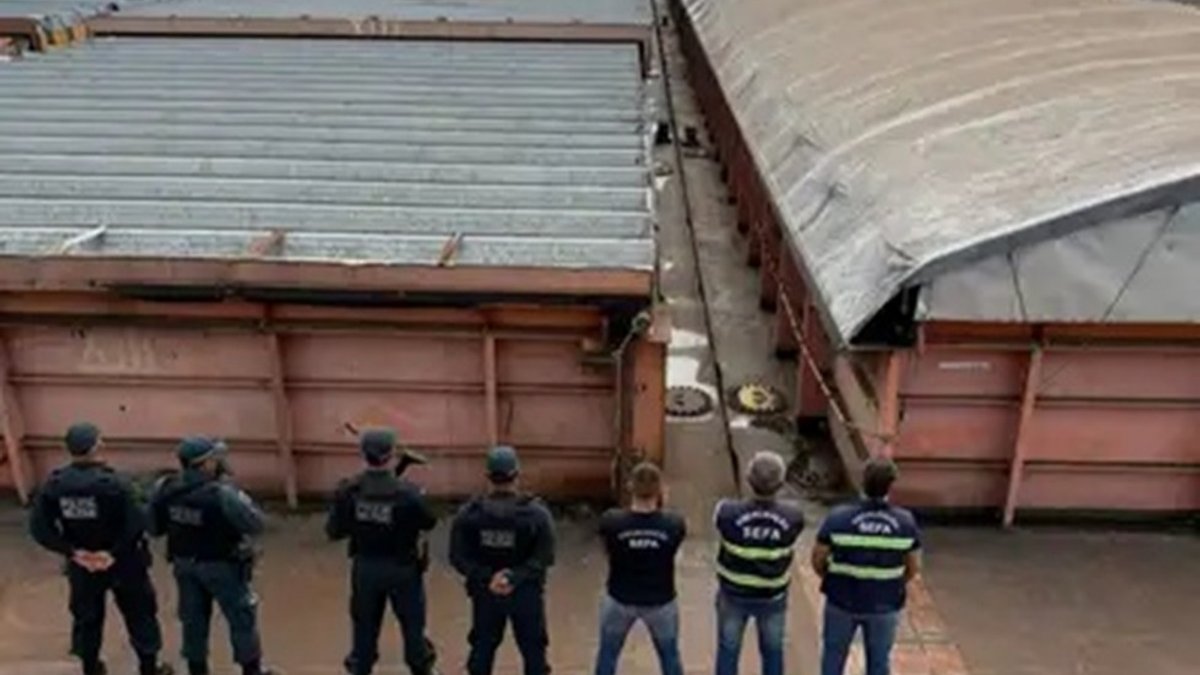
Soybean cargo valued at R$86 million is retained during operation on the Tapajós River
Credits: Sefa
An inspection operation carried out by the State Secretariat of Finance of Pará (Sefa) resulted in the seizure of 43,078.9 tons of soybeans transported in a convoy made up of 16 bulk ferries on the Tapajós River, near Santarém, in western Pará.
The cargo, valued at approximately R$86.1 million, had left the municipality of Itaituba (PA) with a declared destination of Santana (AP). During the analysis of tax documentation, auditors identified inconsistencies related to the taxation of the operation and proof of the destination of the goods for export.
Super Rectangle (728×90) – Position 17
According to the inspection, the carrier responsible for the cargo issued the Electronic Bill of Transport (CT-e) for the state of Amapá without paying the ICMS due to Pará. The operation was presented as an export, a condition that would eliminate the incidence of state tax.
However, during the inspection, inspectors discovered the absence of documents considered essential to prove the effective departure of the goods to the international market.
According to Sefa, the only documentation presented was related to the batch formation of the cargo, without the issuance of invoices or other records that formally proved the export of the product.
The action was led by the Tapajós Transit Goods Control Coordination, with support from the Pará Military Police and the Regional Finance Coordination in Santarém. The work included prior information gathering and monitoring of the logistical operation before the convoy approached.
As a result of the inspection, two Terms of Seizure and Deposit (TADs) were drawn up, totaling R$ 30,044,902.59 between tax due and fines applied.
Strategic export corridor
The Tapajós River is part of one of the main logistical corridors used to transport agricultural production from the Brazilian Center-West towards the ports of Arco Norte. In recent years, the region has recorded significant growth in the movement of grains, especially soybeans and corn destined for the foreign market.
The increased use of waterways has also increased the attention of supervisory bodies on transport and export operations, especially in relation to the tax and documentary regularity of cargo.
Inspection reinforces control over exports
The operation highlights the importance of complying with tax and customs requirements in operations linked to foreign trade. Documentary proof of export is essential for the application of tax benefits provided for in Brazilian legislation.
Experts highlight that the correct formalization of operations guarantees legal security for exporters, transporters and logistics operators, in addition to ensuring tax collection in the states involved in cargo movements.
The cargo remains under control of the tax authorities until the tax and documentary situation identified during the inspection is regularized.