Wilson Sons tests biofuel on tugboats at Porto do Açu
Vast Infrastructure – Disclosure
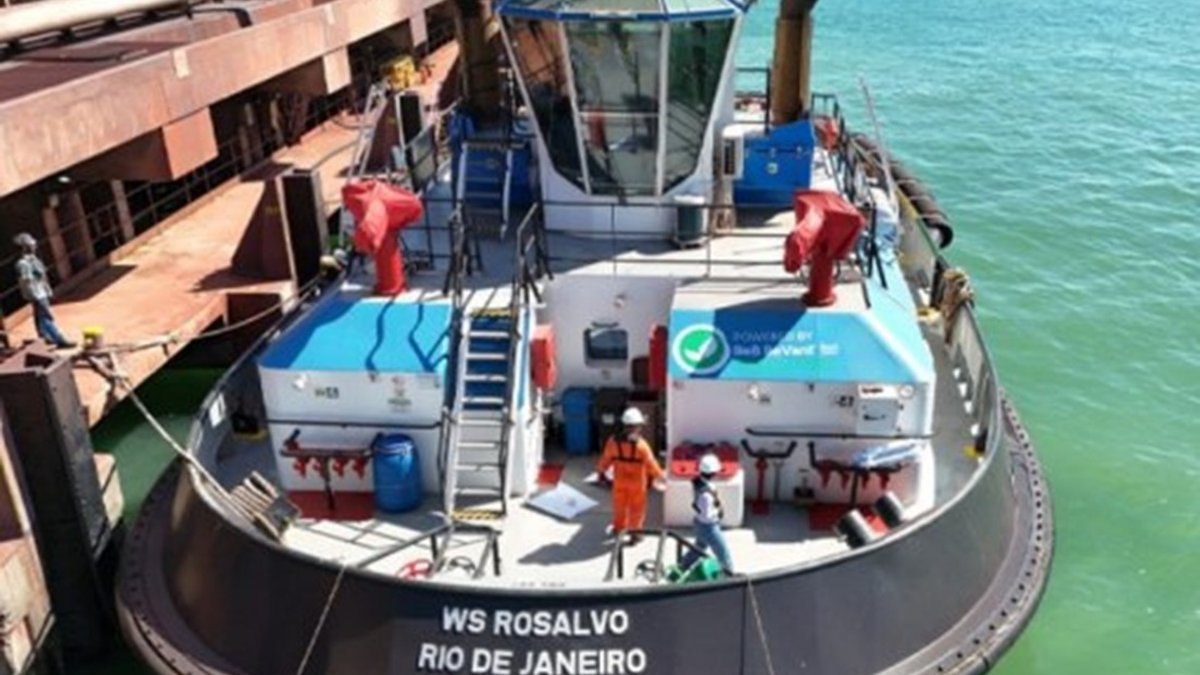
Wilson Sons began a test with biofuel in tugboats, at the Ferroport iron ore shipping terminal, at Porto do Açu, in São João da Barra. The initiative, aimed at decarbonizing operations, used the Be8 BeVant, developed by Be8, on the WS Rosalvo tug, with the expectation of reducing carbon dioxide (CO2) emissions by up to 99% compared to marine diesel oil.
Super Rectangle (728×90) – Position 17
During the tests, performance, durability and emissions analyzes will be carried out, using telemetry from WS Rosalvo to prepare a report with the project’s conclusions, which will be submitted for international certification.
Ferroport’s Sustainability Manager, Edenilson Sanches, highlighted the importance of the initiative. “This project has the potential to reduce the port’s indirect emissions as a whole, also contributing to the reduction of Anglo American’s indirect emissions, through the reduction of Wilson Sons’ direct emissions, representing a joint effort by the entire port community to implement more efficient operations from an energy point of view and with lower carbon intensity”, he stated.
In the view of the executive director of Tugboats at Wilson Sons, Márcio Castro, tests with the new biofuel reinforce the importance of strategic partnerships, reaffirming Wilson Sons’ commitment to decarbonization. “We are always looking for new technologies that contribute to the safety, efficiency and sustainability of the port sector”, he highlighted.
In 2025, Wilson Sons and Vast also carried out the first tests on the use of HVO (Hydrotreated Vegetable Oil) in the Brazilian maritime sector. HVO, known as renewable diesel or green diesel, was used in Wilson Sons tugboats, which operate in Porto do Açu, replacing marine diesel oil.
Be8 BeVant is a biodiesel “drop-in”
Produced at the Be8 plant in Passo Fundo (RS), from soybean oil, animal fat and used cooking oil (UCO), Be8 BeVant is a “drop-in” biodiesel. This way, it is used directly in the vessel’s engine, without the need to change the structure.
“We are talking about a biofuel developed and produced in Brazil, which delivers technical performance similar to conventional fuel and, at the same time, generates a transformative environmental impact, without investment costs for equipment transition”, said the president of Be8, Erasmo Carlos Battistella.
According to the director of Energy Transition at Be8, Camilo Adas, he pointed out that there were two years of chemical development and another year of testing on a test bench, in partnership with companies like Mahle.
“Our idea was simple: if we are going to create a product for 100% pure use, without mixing, let it be the best possible for that. We wanted an ideal product, which could be used directly in the engine without changing absolutely anything in the infrastructure chain”, explained the executive.
Thus, the process included several cycles of tests, reformulations and joint work with strategic partners to ensure quality, energy efficiency and regulatory viability. Even with the advantages, the challenge of popularizing biofuels in Brazil is still significant. For Adas, the main obstacle is cultural and historical.
“Common sense is still fossil. When Henry Ford started producing his vehicles, he used corn ethanol. Rudolf Diesel himself presented his engine powered by peanut oil. But the geopolitical force of oil imposed itself, shaping a system that dominated the world for more than a century”, added the executive.