
Beyond the AMR: Rockwell’s Production Logistics Strategy Connects Material Flow to Plant Autonomy
An analyst perspective on why orchestration, digital twins, and plant-floor integration matter more than the robot alone Production logistics becomes a control problem Rockwell Automation’s press conference presented a clear thesis: the next major…
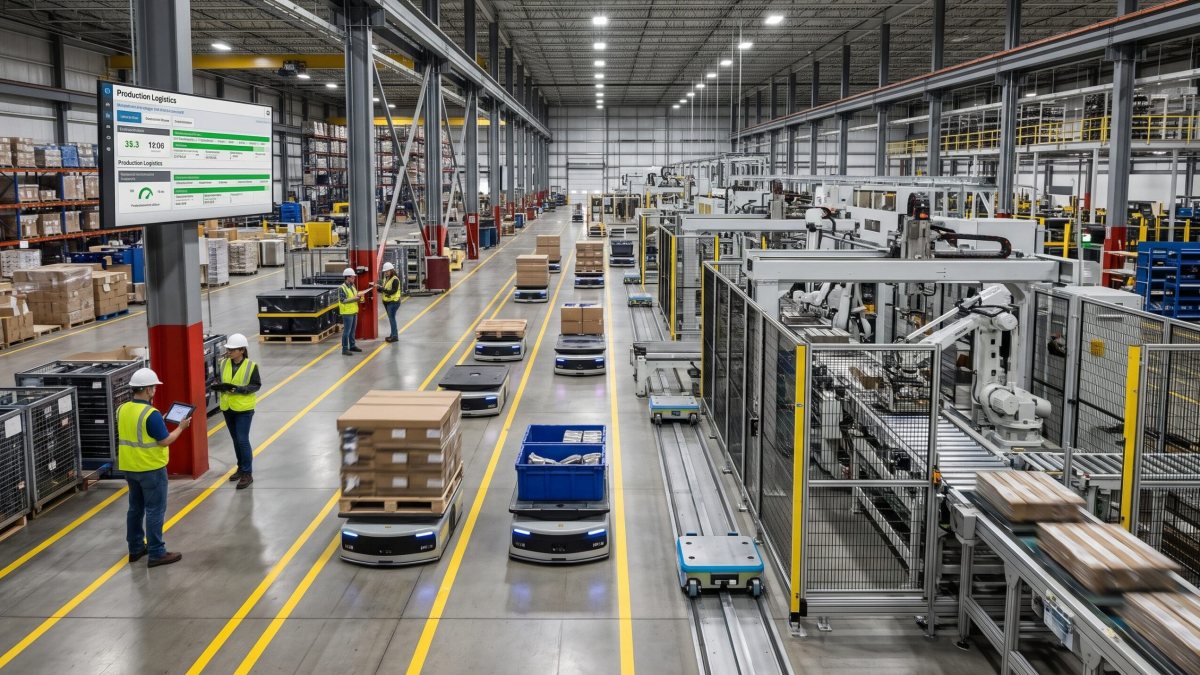
An analyst perspective on why orchestration, digital twins, and plant-floor integration matter more than the robot alone
Rockwell Automation’s press conference presented a clear thesis: the next major productivity opportunity lies in the space between automated processes. Many factories have sophisticated machines and well-instrumented production lines, yet material still arrives through manual, disconnected workflows. The result is a familiar contradiction: a highly automated line can still depend on a forklift driver or an operator pushing a cart at its boundary.
“At the end of the line, there was a person driving a forklift and a person pushing a cart.”
That gap is where Rockwell is positioning production logistics. Rather than treating intralogistics as a stand-alone robotics project, the company describes an end-to-end workflow spanning production software, orchestration, controls, autonomous mobile robots, independent cart technology, and human work. This is a stronger industrial proposition than simply adding AMRs to a fleet. It treats the movement of work-in-process, components, packaging, and finished goods as part of the production system itself.
This story was originally published by Logistics Viewpoints. Read the full story at Logistics Viewpoints →


Conversation